


Thomas à Kempis did not write from a quiet room.
History remembers him as a fifteenth-century German-Dutch monk, deeply rooted in the counter-cultural Devotio Moderna (Modern Devotion) movement - a religious “revival” of sorts that exhorted the believer to extreme personal humility, obedience and simplicity in their faith walk.
He is the author of The Imitation of Christ—a spiritual masterpiece that remains the second best-selling Christian book in history, surpassed only by the Bible.
Yet, à Kempis did not enter the world in a peaceful time or place. Instead, he stepped into a Western Europe that looked like the absolute end of the world.
For perspective and context, consider our recent memory.
The COVID-19 pandemic that swept the world and gripped the global consciousness in the early 2020s took an estimated 7 million lives.
The Black Death, by conservative historical consensus, extinguished 75 to 200 million lives worldwide in a brief four-year span from 1347 to 1351.
À Kempis began his earthly stay shortly after the peak of that initial terror.
Yet secondary and tertiary waves of related pandemics continued to obliterate millions over the span of his long life—an incredible ninety-two years of continuous crisis.
And the carnage wasn’t limited to the rat-borne bacterium Yersinia pestis. Outside his monastery walls, the impending bloodbath of the Hundred Years’ War was actively staining the continent’s soil red.
Inside the institutional church, things were no better—a deep, bitter Papal schism had fractured Christendom down the middle.
Of course, there were no 24-hour, infinitely updated newsfeeds at the time, but from our modern vantage point, today’s news cycles look fairly rosy by comparison.
By any estimation, à Kempis’s century was completely saturated by grim, catastrophic tragedies.
And to top it off, a massive, destabilizing technological shift was looming just over the horizon: the printing press was about to fundamentally and forever change how the human animal accessed, consumed, and distributed information.
And here lies a bit of intriguing irony in our story.
À Kempis wrote his manuscript to pull people out of the distractions of the day—to encourage the common soul to subtract the clutter of the world and sit in intentional, undistracted, quiet meditation before God.
Yet, the moment Johannes Gutenberg’s mechanized press roared to life, the Addition Machine claimed the monk’s work as its first premium fuel.
The Imitation of Christ was rapidly duplicated by the thousands, becoming one of the most mass-produced, widely distributed printed titles in the Western world, second only to the Bible itself.
The very text engineered to preach absolute quiet was instantly transformed into a high-volume product of the brand-new information industry. The monk’s pure signal was immediately weaponized by the machinery of addition.
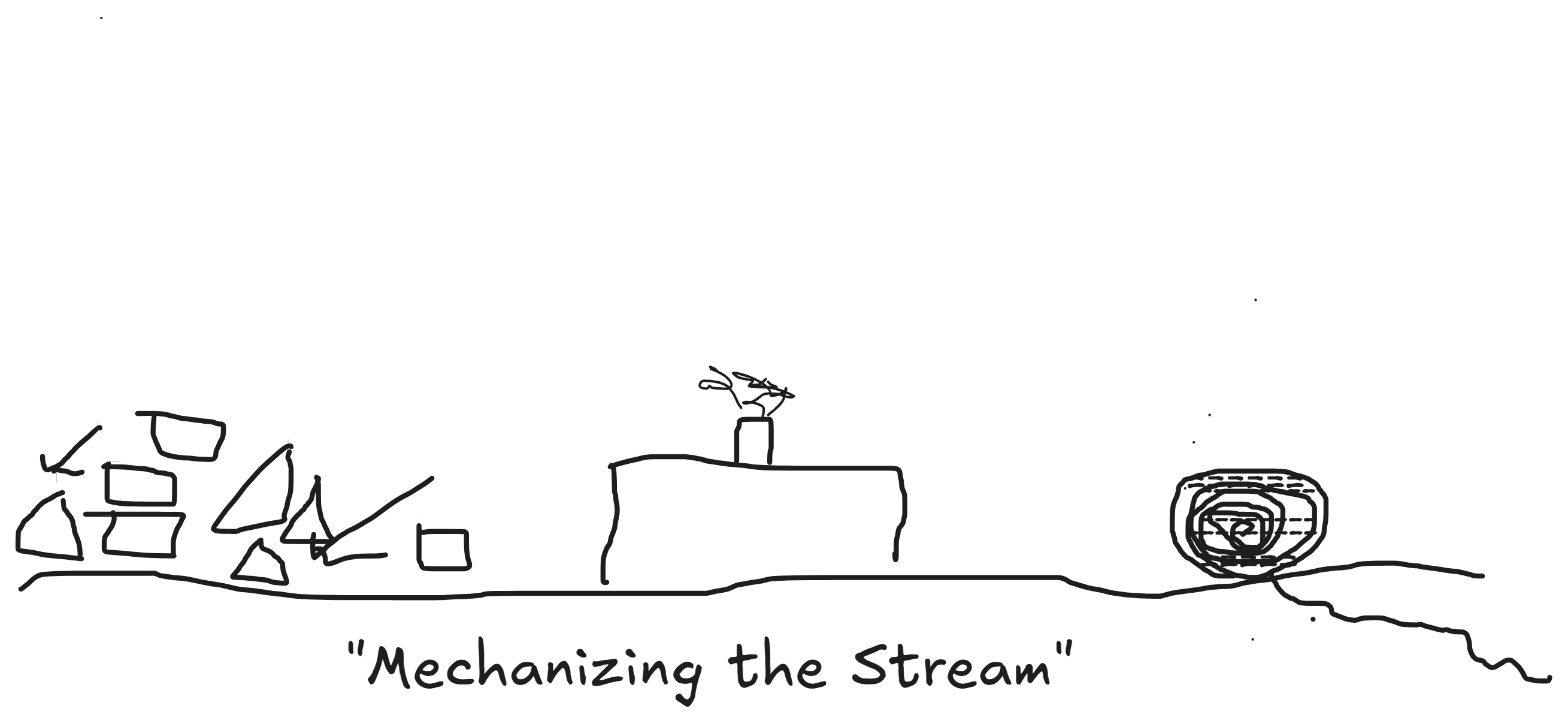
So a 15th-Century Monk Walks into a Coffee Bar…
Imagine the old Augustinian monk stepping through a tear in time and walking into a modern coffee bar in Any Town, USA.
What would he see?
He would look at the rows of tables filled with humans staring intently yet blankly into buzzing, glowing rectangles.
He wouldn’t understand the silicon, the microchips, the high-speed fiber-optics, or how to connect to the free Wi-Fi.
Yet in that regard, he wouldn’t be much different than most of us—who rarely, if ever, consider the infrastructure behind our next shot of digitally-delivered dopamine.
But within ten seconds, he would recognize the exact spiritual state of the room.
He would see that the human mind was doing precisely what it did in 1420: fleeing inward quiet to accumulate meaningless cognitive candy.
He would realize that we are fighting the exact same battle he fought along the Rhine Valley—a war against the constant accumulation of “noise” in our mental loops.
Because à Kempis saw something darker than a literal plague. He looked at the human inclination to look outward—to constantly consume, debate, and tinker—and realized the real battlefield wasn’t outside the monastery walls.
It was inside the human heart, mind and soul.
The Machinery of Faith
To fully comprehend why a fifteenth-century monk would spend decades scratching a massive, uncompromising blueprint for human simplicity onto parchment, we must look at the specific institutional rot he was trying to outrun.
Thomas à Kempis looked at the cultural architecture of his day and saw three distinct additions cluttering the airwaves:
Academic arrogance,
Institutional vanity,
And a massive wall erected between everyday folks and the divine.
The universities of Western Europe had become factories of useless intellectual posturing and chaos.
Brilliant men spent their entire lives engaged in hyper-complex, pedantic theological debates—arguing over abstract doctrines while their actual attitudes remained transactional, vain and impersonal.
The church structure itself had transformed into a massive machine of materialism, where spirituality was treated as a commodity to be bought, sold, and institutionalized.
À Kempis witnessed this vain intellectual parade and chose a radical path of subtraction. His solution was a quiet, devastating rejection of the elite status quo.
He bypassed the complicated academic debates entirely.
He argued that it is infinitely better to feel contrition in your heart than to be able to define it to a room full of nodding scholars.
And, in a move that would inadvertently lay the groundwork for a massive historical shift called the Protestant Reformation decades later, he insisted that this quiet, inner path belonged entirely to the laity.
These, of course, were the everyday commoners, the ordinary souls who didn’t speak Latin or hold university degrees.
He was telling the everyday man and woman that the kingdom of heaven wasn’t hidden behind an expensive institutional paywall or a dense thicket of vocabulary.
It was sitting quietly in their own rooms, waiting to be claimed.
The Fifty-Two Week Experiment
And that brings us to the business at hand.
Beginning next week, The Subtraction Machine is embarking on a year-long diagnostic experiment.
We are taking Thomas à Kempis’s five-hundred-year-old guide to radical interior survival, stripping away the archaic medieval syntax, and translating its brutal, beautiful core principles into a language our modern cognitive machines can actually process.
This will not be an exercise in academic theology, nor will it be a collection of comforting, bite-sized daily devotionals designed to help you self-actualize. It is a systematic roadmap for subtraction.
The rules of this experiment are simple, though deliberately out of step with the times:
One Chapter a Week: The Addition Machine demands infinite scrolling and rapid consumption. We will do the opposite. We will take one single, compressed theme every seven days and let it sit on the workbench of your mind.
Zero Clutter: No algorithmic tracking, no sensational headlines, and no toxic social feeds. Just the text, the hand-drawn blueprints, and a quiet, deliberate space for community reflection.
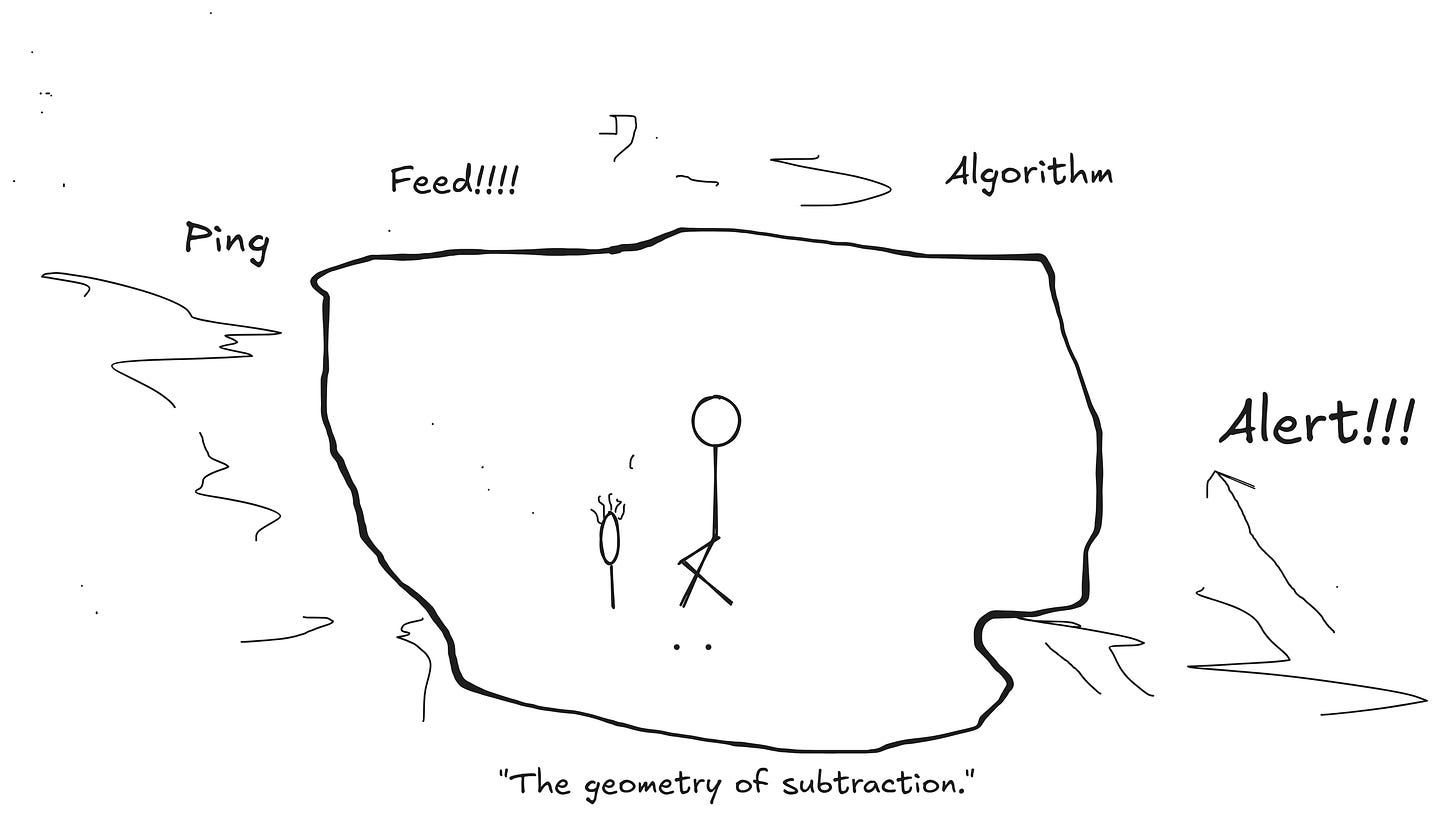
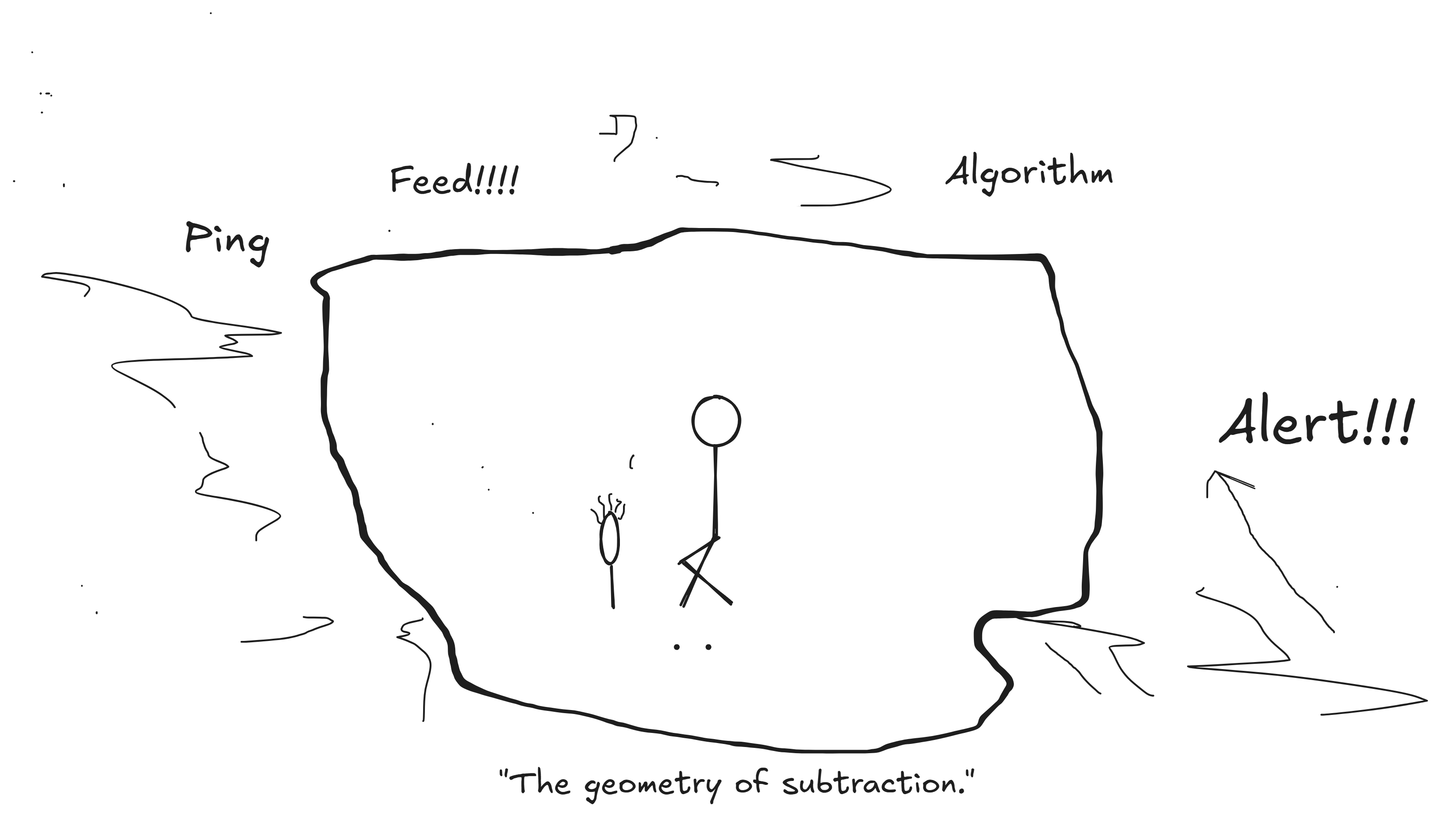
We are building a small, intentional sanctuary away from the relentless din of digital noise—a patron-supported corner of the internet for those who suspect that the modern world’s constant accumulation is actually a slow, gentle form of spiritual bankruptcy.
Turn down the volume on your dashboard. Put the glowing rectangle flat on the desk.
The introductory remarks are officially concluded. Let us step out of the noise of the century, open the door to the inner room, and begin.
Installment #1 drops next week.
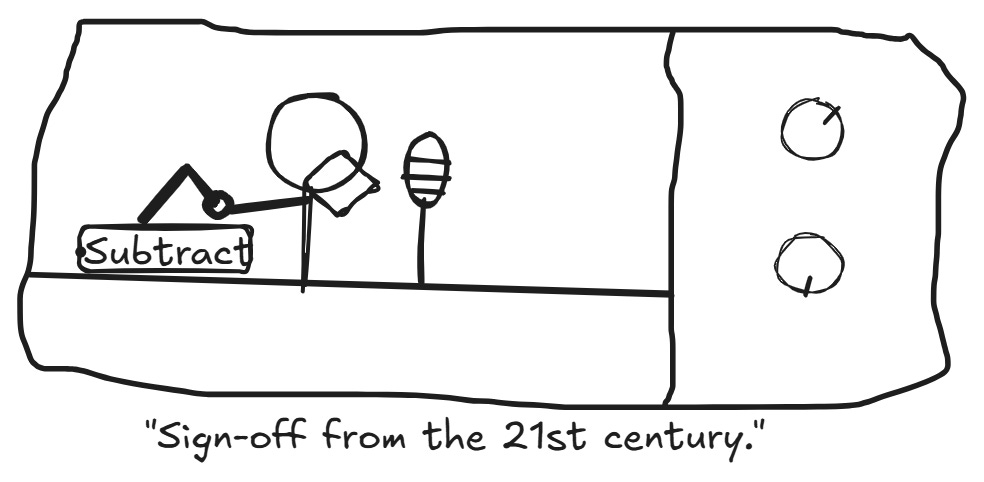
To support this independent space or bring the clarity of subtraction to your own project’s philosophy, visit our foundation page.