

Welcome to The Subtraction Machine and installment #4 of our year-long modernization, dissection, and weekly exploration of Thomas à Kempis’s 15th-century Christian classic, The Imitation of Christ.
(New to this daring experiment? Read the prologue and rules of engagement here.)
The Augustinian monk penned his masterpiece on radical subtraction and Godly submission set against a backdrop of unimaginable tragedy. Outside the walls of his monastery, the gears of a violent, catastrophic century ground medieval Europe to dust.
The Hundred Years’ War raged across the continent, leaving blood and futility in its wake. Meanwhile, rolling waves of a relentless, rat-borne infestation—Yersinia pestis—extinguished the lives of millions worldwide.
It’s hard to imagine a more jarring and tragic backdrop as the setting for such a contemplative and aspirational body of work—modeling the life and actions of Jesus Christ.
The Monk’s Text Fragment
For today’s installment, we’re returning our modern microscope to Book 1, Chapter 1 of The Imitation of Christ. We’ll focus on the good Monk’s admonishment against the accumulation of knowledge as the ultimate spiritual hustle.
His pronouncement hits more like a theological hammer than it does a gentle nudge.
Thomas à Kempis drops his anvil right on the doorstep of the academic elite—the same self-inflating university scholars of the era who spent their lives bickering over arcane doctrinal positions:
“For what would it profit us to know the whole Bible by heart and the principles of all the philosophers if we live without grace and the love of God?”
— Thomas à Kempis, The Imitation of Christ (Book 1, Chapter 1)
The monk’s observation is both simple and deeply profound. The Addition Machine—the world and its frantic metrics of accumulation—endlessly hectors us to stack up data points disguised as true knowledge.
And yet, the monk’s fifteenth-century warning was itself a direct echo of an even older, more primary source: the Apostle James.
The apostle was speaking into the same metaphysical microphone when he famously warned against being idle “hearers only, and not doers.”
Here’s the full text from James:
“But be doers of the word, and not hearers only, deceiving yourselves. For if anyone is a hearer of the word and not a doer, he is like a man observing his natural face in a mirror; for he observes himself, goes away, and immediately forgets what kind of man he was. But he who looks into the perfect law of liberty and continues in it, and is not a forgetful hearer but a doer of the work, this one will be blessed in what he does.”
— James 1:22-25
The core of the Apostle’s directive is clear: The Addition Machine wants us to believe the timeless lie that consuming information is the same as undergoing a fundamental spiritual transformation.
The Subtraction Machine demands that we step out of the gallery and into the quiet field of lived experience.
The Eyewitness Confession: The Substack Paradox
Dear reader, I am on this long journey with you—and I have an embarrassing admission to proffer.
I set The Subtraction Machine in motion to build a sanctuary of intentional reduction, a space to silence the noisy signals of the world.
Yet, like all short-sighted pilgrims, I regularly forget to look at the map.
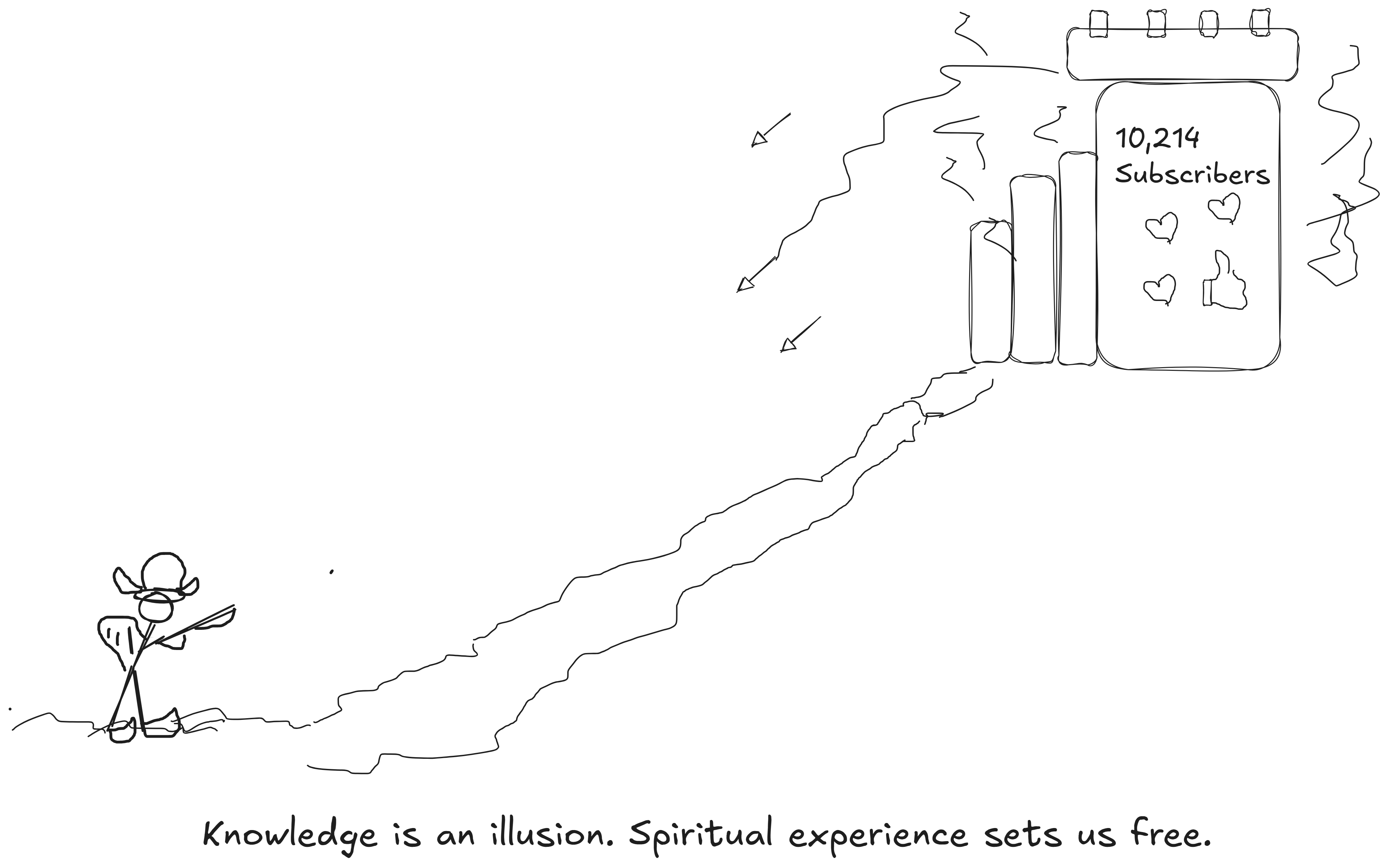
The unvarnished truth is that I am a data addict. I routinely find myself caught in the seductive analytics traps of this very forum.
How many new subscribers? (Never enough!) How many likes, shares, and page views?
The early Spanish conquistadors dreamed of the mythical golden city of El Dorado; they died in the mud of the rain-drenched Amazon jungle chasing their delusion.
In my own compromised imagination, that glittering mirage takes the precise shape of 10,214 hungry subscribers, each of them hanging on my every word.
Vanity.
The Time-Traveling Monk
If Thomas à Kempis were to step through a tear in time and walk directly into our modern workplaces, living rooms, and coffee shops, he wouldn’t need a single course in Software as a Service models, cloud computing, or algorithmic tracking.
What he would immediately and intuitively recognize is our ancient pathology: an obsession with accumulating the “right” knowledge, a desperate worship of measurements, and our frantic attention to the passing debris of the day.
If he caught us staring at our social media analytics dashboards, our corporate KPIs, or our hyper-curated reading lists, his advice would be as stark as his stone cell:
Stop studying the glass. Drop the metrics.
He would tell us to turn our undivided attention away from the digital scoreboards and face the raw, transformative weight of a life actually lived in the Spirit.
The Weekly Assignment: Put Passing Knowledge in Its Place
This brings us to our collective assignment for the week—an active, conscious focus on lived experience and an intentional sidelining of the endless parade of ephemeral data.
Our world spins on metrics. Let’s put them in their place for the next seven days.
Here is how we will do it:
The Trigger: When you feel the familiar, twitchy urge to check your metrics—whether that means opening your Substack analytics, refreshing your social media views, tracking your portfolio valuation, or counting the unread books on your bedside table.
The Mechanics: Pause. Instead of feeding the digital meter, turn away from the screen or the stack. Treat the data-gluttony like a low-ranking gear grinding away in an empty room. Let the impulse to track, measure, and score your life sit quietly until it evaporates—which it will.
The Result: We will discover that our worth does not fluctuate with the shifting math of human approval. By refusing to tally the mirror, we intentionally collapse the hustle—and step back out into the open field of a life actually lived.
Take your eyes off the dashboard. Let the tracking software run silently and unmonitored in the background.
And as we closed segments two and three:
Let it be.
To support this independent space or bring the clarity of subtraction to your own project’s philosophy, visit our foundation page.