

Greetings and welcome, fellow travelers.
This is the first drop, the first serialized issue of our year-long experiment in subtraction. Here is the blueprint.
We are taking a drop-by-drop, and sometimes line-by-line, deep dive into Thomas à Kempis’s Christian classic, The Imitation of Christ. If you have read any of the previous thought exercises on this new and intimate forum, The Subtraction Machine, you will recognize the theme.
This quiet, small destination is an intentional and systematic exploration of reducing the “noise” and signal interference in our lives.
We are attempting to build a more unpolluted and user-friendly Graphical User Interface (GUI)—to borrow a term from the world of technology—with the Divine.
If you have not read the prologue, you can find it here. It introduces the remarkable times and life of à Kempis, detailing the grim and violent era in which this medieval, 15th-century monk spent decades crafting his ideas on radical simplicity—blueprints for a fulfilling and faithful life.
But for now, let us proceed with the experiment. Read on for the first installment of what we sincerely hope will be an epic and transformative journey for you—and us.
The Monk’s First Radical Challenge
Behind this introduction sits the absolute bedrock. What follows are the opening lines of Book 1, Chapter 1 of The Imitation of Christ—the precise thematic center for this first installment of our 52-week experiment.
This is Thomas à Kempis’s definitive thesis statement, a radical instruction on narrowing the human focus. It represents the singular, uncompromised anchor of a mammoth spiritual instruction manual work he spent decades scratching onto parchment.
Turn the volume down. Look closely at his simple instructions for enlightenment:
“He that followeth Me, walketh not in darkness, saith the Lord. These are the words of Christ, by which we are admonished how we ought to imitate His life and manners, if we will be truly enlightened, and be delivered from all blindness of heart. Let therefore our chief endeavor be to meditate upon the life of Jesus Christ.”
Jesus Christ: The Original Act of Subtraction
Again, let’s allow the monk’s last line from the passage to sink deeply into our thoughts about the week ahead of us—a week certain to be steeped in the noisy signal interference of our busy world:
”Let therefore our chief endeavor be to meditate upon the life of Jesus Christ.”
To understand what it means to truly imitate His life and manners, we must look past the soft, sanitized, and therapeutic versions of Christ handed down by modern consumer culture.
Within the landscape of first-century Judea, Jesus was the ultimate cultural and spiritual subtractor.
He declared in John 14:6:
“I am the way and the truth and the life. No one comes to the Father except through me.”
Here, Jesus was executing an act of institutional demolition. With a single sentence, He completely obliterated the oppressive, labyrinthine grid of laws kept and watched over by the Pharisees, Sadducees, and the religious gatekeepers of the day.
By asserting that He alone was the way, the truth, and the life, Jesus positioned Himself as the ultimate reductionist. The massive curtain of the Temple—the physical barrier symbolizing the ultimate separation between humanity and God—was torn wide open.
Let’s explore some of the religious mandates and requirements Jesus was completely tearing out of the religious machinery of the day.
And let’s not forget the life-changing power embedded in His words. Jesus was telling the reader of the era that He—not endless adherence to seemingly infinite religious laws—was the gateway to salvation, the solitary bridge to God, the Father.
The Labyrinth of Religious Addition
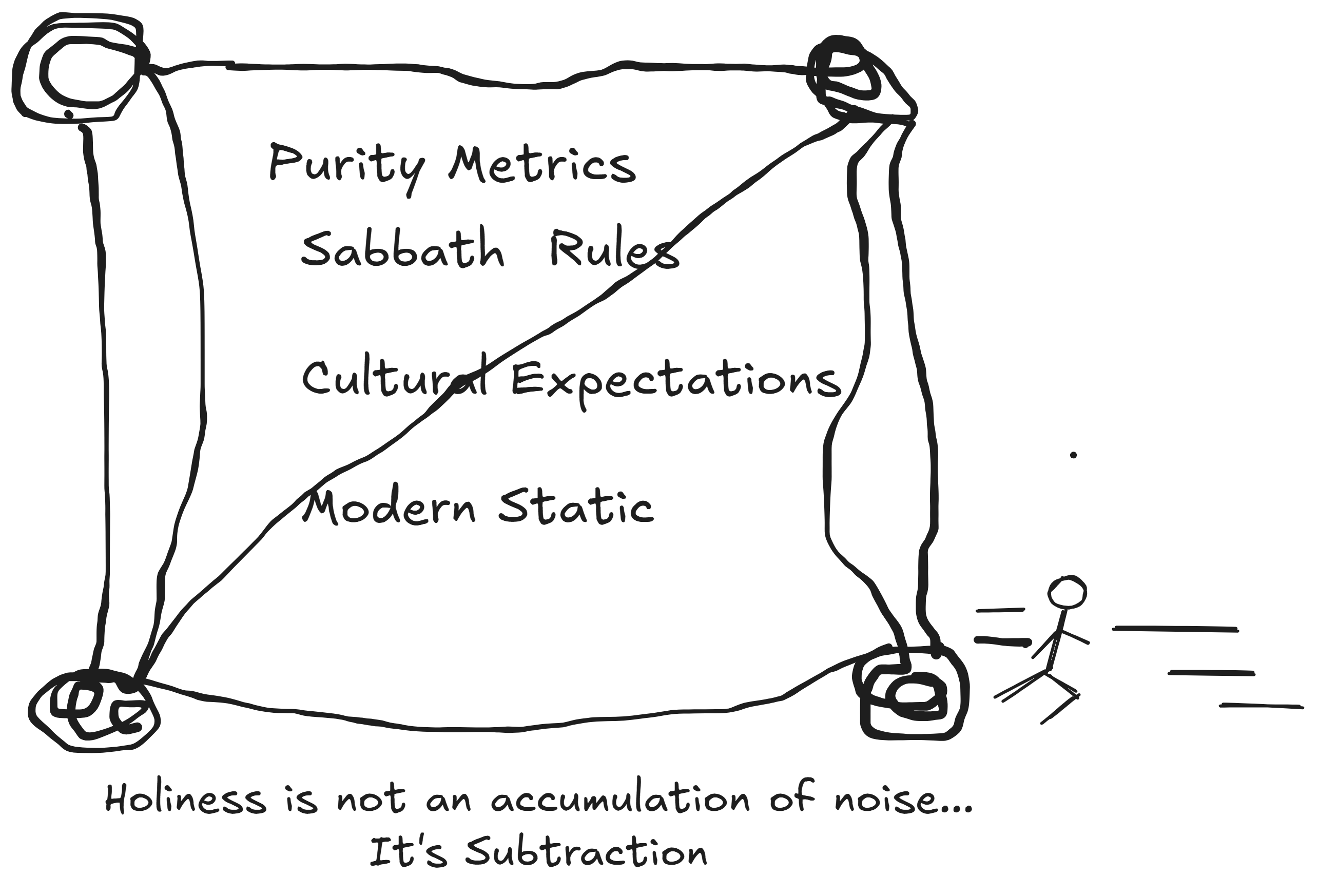
First-century religious culture was an absolute fortress of “Addition.” The ruling scholars had constructed an incredibly complex, transactional machine of righteousness, adding thousands of granular rules and metrics to dictate every spec of human behavior:
The Oral Law (Halakhah): Over centuries, scribes created an endless web of oral traditions designed to ensure ordinary people did not accidentally trip over the written commandments of the Torah. It turned daily life into a minefield.
The Purity Trap: Exorbitant rules governed ritual uncleanness. Contact with the sick, outcasts, or certain animals required immediate isolation, complex purification baths, and waiting periods.
The Sabbath Cage: The beautiful, horizontal requirement to rest was warped into hundreds of rigid, hair-splitting restrictions. Carrying a minor object, tying a common knot, or walking a few paces too far were codified as “sins against God.”
The Metric Obsession: Religious elites demanded tithing down to the literal spices in a kitchen garden—painstakingly counting out every tenth leaf of mint, dill, and cumin. Normal meals were transformed into demanding, legalistic rituals of ceremonial handwashing and vessel-scrubbing.
The Pharisees didn’t just create laws; they built a rigid behavioral registry. They transformed the vast, living mystery of faith into a standardized index of behavioral code—laying out every allowable movement to ensure the observant believer never had to think, feel, or look at the horizon of their lives.
What the keepers of the law insisted they were absolutely required to do was to focus on the legalistic minutiae of the right here and now.
The Radical Baseline
Jesus didn’t try to reform their checklists, optimize their enforcement, or adjust their metrics. He threw them out.
He democratized holiness by declaring that physical contact with the “unclean” cannot pollute a human; defilement comes only from an unexamined interior life and refusal to submit to God.
He bypassed their institutional mediation entirely, offering direct, un-entangled access to the Father in secret. Finally, He collapsed their mountain of 613 laws into a singular, beautiful directive from Matthew 22:37-39:
“Love the Lord your God with all your heart and with all your soul and with all your mind. This is the first and greatest commandment. And the second is like it: ‘Love your neighbor as yourself.’”
A Modernized Interpretation from The Subtraction Machine
“If you actively follow Me, you will no longer stagger through the blindness of the dark,” says the Architect of Salvation, Jesus Christ.”
These are the direct instructions of Jesus—and they carry no promise of an easy, optimized life. Christ is not offering a therapeutic trick to lower the background noise or calm your daily schedule.
In fact, the path requires total preparation for a life of friction: you are explicitly warned that to walk this out is to invite the intense persecution of an Addition Machine—which is the world and its institutions—that despises His name.
The monk is not teaching us how to manage our distractions. He is making a brutal observation: Christ—and exclusive, relentless meditation upon His life, manners and sacrifice—is the solitary gateway to Salvation, the only functioning bridge to the Father.
*Turning off the world’s static is not the destination; it is simply the mandatory clearing of the lens so that your entire existence can be fiercely re-anchored to the Person who stands at the door.
They are an explicit warning that if we want to see the floorboards of our own lives clearly—if we want to cure the deep deafness that makes us mistake institutional static for authentic truth—we have to stop managing the background noise and start imitating the actual texture and contours of His days.
To imitate Him is not an exercise in passive, sanitized piety.
It is a calculated, day-by-day refusal of the crowd’s momentum. It means studying the manners of God incarnated as a man who walked away from the bureaucratic checklists of religious elites, bypassed the political funnels of His era, and routinely slipped away into the absolute silence of the lonely places to stand in solitude before the Father.
Therefore, our primary work—our main act of resistance—must be to slow down long enough to examine the quiet, uncompromised geometry of that specific life. This opening salvo to à Kempis’s master work embeds the central theme the monk would explore for all of his days.
The Message from the Cloister
This is not romantic nostalgia. It is a mental and spiritual reclamation.
Modern clinical trials validating total digital subtraction show that when humans aggressively block the digital network, 91 percent experience an immediate, massive surge in mental well-being.
More shockingly, the removal of that digital noise reverses the equivalent of 10 years of attention decline.
If this is true of our mental well-being, then ponder for a moment what it will do for our spiritual health. What the monk discovered in the cell, the lab has verified in the scanner: subtraction is the only path back to a functional mind and soul.
The Active Subtraction Directive
And now on to this week’s spiritual assignment. For the next seven days, you are to become entirely undivided for the first 15 to 30 minutes of your morning.
Before the smart gadget is touched, and before the noise of the century enters your eyes, you will sit in the quiet with a blank sheet of paper.
Meditate on the life of Christ, and physically write down what you are choosing not to care about today.
Protect the firewall of the morning cell.
The transmission will re-open for Chapter 2 next week.
To support this independent space or bring the clarity of subtraction to your own project’s philosophy, visit our foundation page.