

Welcome to The Subtraction Machine and installment #8 of our year-long modernization, dissection, and weekly exploration of Thomas à Kempis’s 15th-century Christian classic, The Imitation of Christ.
(New to this daring experiment? Read the prologue and rules of engagement here.)
It’s 7:28 on a Thursday evening, and I’ve just walked into Portable Building #2, sequestered on the far left side of the church parking lot.
The last stragglers are entering the room, and two are still in the parking lot making sure they pull the last life out of the third pre-meeting Pall Mall menthol before rushing to join the room.
AA meetings always start precisely on time, and end exactly one hour later—to the minute. I’ve always found it a bit ironic that people who’ve managed to make such a mess of their lives are such sticklers for time.
I’m in long-term recovery from alcohol, and so I’m certainly not speaking from a perch of judgement.
But I’ve noticed a few idiosyncrasies over the years in meetings, and fastidious time management is one of them.
Swiss trains are famous for their impeccable timing, but they’ve got nothing on a room of sober drunks.
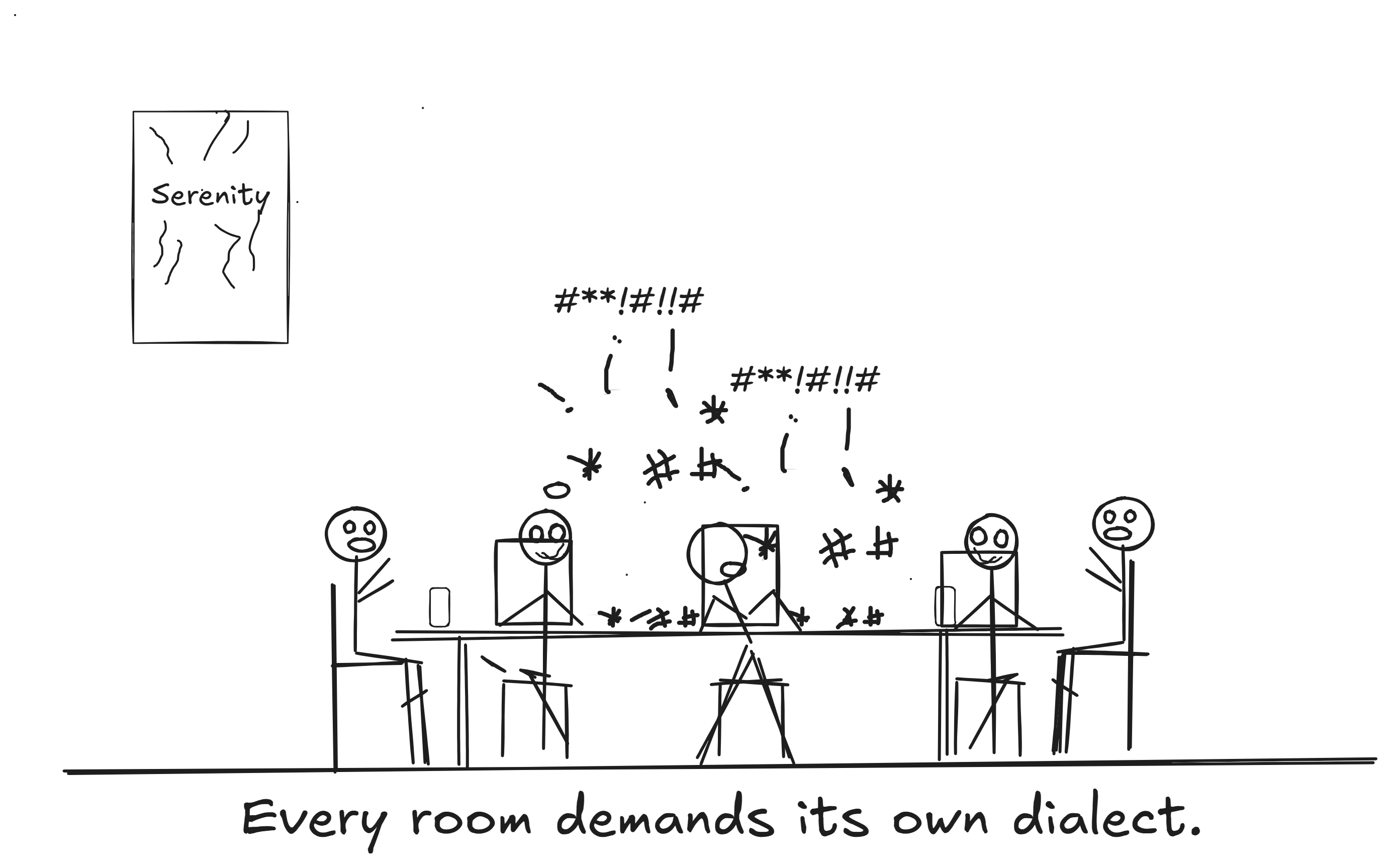
As the meeting kicks into gear and the last Styrofoam coffee cups are filled, the chair introduces the topic, delivers her opening monologue, and announces the floor is open for sharing.
We’re three shares into the meeting, and I can feel it coming, right on time. Just like the Swiss trains.
He’s roughly 40, looks wise to the ways of the world, and then he starts. The F-bombs begin rolling in like an unexpected summer squall.
I’d heard him share many times before, so I was prepared for the fusillade. I started silently counting.
Thirty seconds in, he’s already let six of them fly: two verbs, three adjectives, and one noun. He is an F-Bomb Van Gogh—an artist of the highest order, painting every part of speech with a single word.
It’s brilliant in a way—simultaneously authentic, hyper-kinetic, and grotesquely profane.
His share that evening in portable building #2 achieved just what he intended.
It demonstrated his authenticity to an audience that would immediately “get it.” They understood the pain, suffering, and utter rage at life, God, or both.
The Serenity Prayer, which is recited in unison at the beginning of every AA meeting worldwide, was penned by Reinhold Niebuhr, one of the twentieth century’s most prominent theologians and Christian intellectuals.
Sometimes, in the darker corners of my imagination, I visualize Niebuhr sitting right there with us in Portable #2, wearing a tweed jacket and clutching a cup of lukewarm Folgers.
The eminent scholar is quietly moved that his prayer has touched so many lives—and that the recitation of his work seems to have taken on an almost sacramental role in the room.
Then suddenly, his countenance drops as the sharing starts and the profanity-laced confessionals begin.
Niebuhr’s facial expression becomes an odd mixture of puzzlement, shock, and sheer terror as members recount their latest tribulations to the group.
May God grant him serenity.
The Monk’s Case for Silence
As that meeting closes, let’s open the door to an admonishment from Thomas à Kempis, the fifteenth-century monk, in Book 1, Chapter 20 of The Imitation of Christ.
As you read it, take a look around your own life.
His instructions are in no way limited to the rooms of recovery. The same spectacle I witnessed in that AA meeting goes on in limitless subcultures across every aspect of life—albeit in many without the spotlight on profanity.
We see it everywhere—at work, in the church pew, watching a football game with friends, or sitting in a city council meeting.
Thomas à Kempis captured the phenomenon perfectly:
“No man appears in safety before the public eye unless he first relishes obscurity. No man is safe in speaking unless he loves to be silent.”
— Thomas à Kempis, The Imitation of Christ (Book 1, Chapter 2-)
If the good monk were a 12-step sponsor, he would be the most sought-after one in the meeting.
Even from a distance of six hundred years, he laid his finger on the precise underlying dynamics of our modern condition, long before psychology gave it a name.
And the condition is this: Why was my friend, a fellow pilgrim in sobriety, dropping F-bombs like candy at a Fourth of July parade?
Why do we use one speech pattern in church, another in the stands, and yet another in the corporate conference room?
In short, every subculture and identity group in our lives demands an accepted code of speech.
But the answer underneath that is far more convicting: we are terrified of obscurity, and we do not love silence. This is the precise warning Kempis was issuing so many centuries ago.
To avoid the obscurity of our own quiet hearts, we put on the vocal camouflage of the room to prove we belong.
We rent verbal costumes—disguises we can easily slip on and off, depending entirely on the setting and the circumstance.
In the 12-step room, the costume is often raw, unfiltered profanity to signal unvarnished authenticity—to convey to your fellows that you’ve fully lived the experience they have and that you “identify.”
If you work in the corporate world, executives and low-level employees alike wrap themselves in words and slogans such as “synergy,” “KPIs,” “actionable plans,” and “metrics.”
Words like these create a linguistic bulletproof vest that protects the fragile ego from vulnerability.
And in the church pew, the verbal costume morphs once again.
Here, we adopt a pious cadence and punctuate our language with theological shorthand that signals to the room that we feel safe, all feel safe, and that love is the tie binding us together.
Completely different rooms. Different dialects and energy in the room. But the river of fear running beneath it all is the same.
None of us are safe in speaking until we learn to love the silence.
Active Subtraction Directive: Fasting From the Verbal Costume
This week, Thomas à Kempis isn’t asking you to take a vow of silence or spend your life in a monastery.
He is asking you to think about your speech, consider your audience and when you do speak, let the words flow from your heart.
For the next seven days, let’s practice a deliberate refrain from the verbal costume of the room. Here’s how we’ll do it:
Audit the Entrance: When you walk into the conference room at work, sit down in the church pew, or enter your next city council meeting, tune into the dialect of the room. Pay close attention to your default impulse to reach for accepted jargon, buzzwords, cadence, or the simple desire to show you’re in the know…that you belong in the room.
Embrace a Spirit of Silence: Refrain from speaking when it’s unnecessary. You’ll find your silence often communicates more than your words. Let the silence sit, and refuse to use empty noise as a protective buffer against being invisible.
Speak Only Un-Engineered Truth: When you do speak, speak strictly from your own heart and mind—not from a spirit of fitting in, and not from the pre-packaged script of the group. If you can’t say it authentically without the group’s armor, don’t say it at all.
Remember the monk’s rule: No one is safe in speaking unless they love to be silent.
Take off the costume.
Embrace the Silence.
Let it be.
To support this independent space or bring the clarity of subtraction to your own project’s philosophy, visit our foundation page.