

Welcome to The Subtraction Machine and installment #12 of our year-long modernization, dissection, and weekly exploration of Thomas à Kempis’s 15th-century Christian classic, The Imitation of Christ.
(New to this daring experiment? Read the prologue and rules of engagement here.)
Morning Coffee with Mom and the Revolutionary
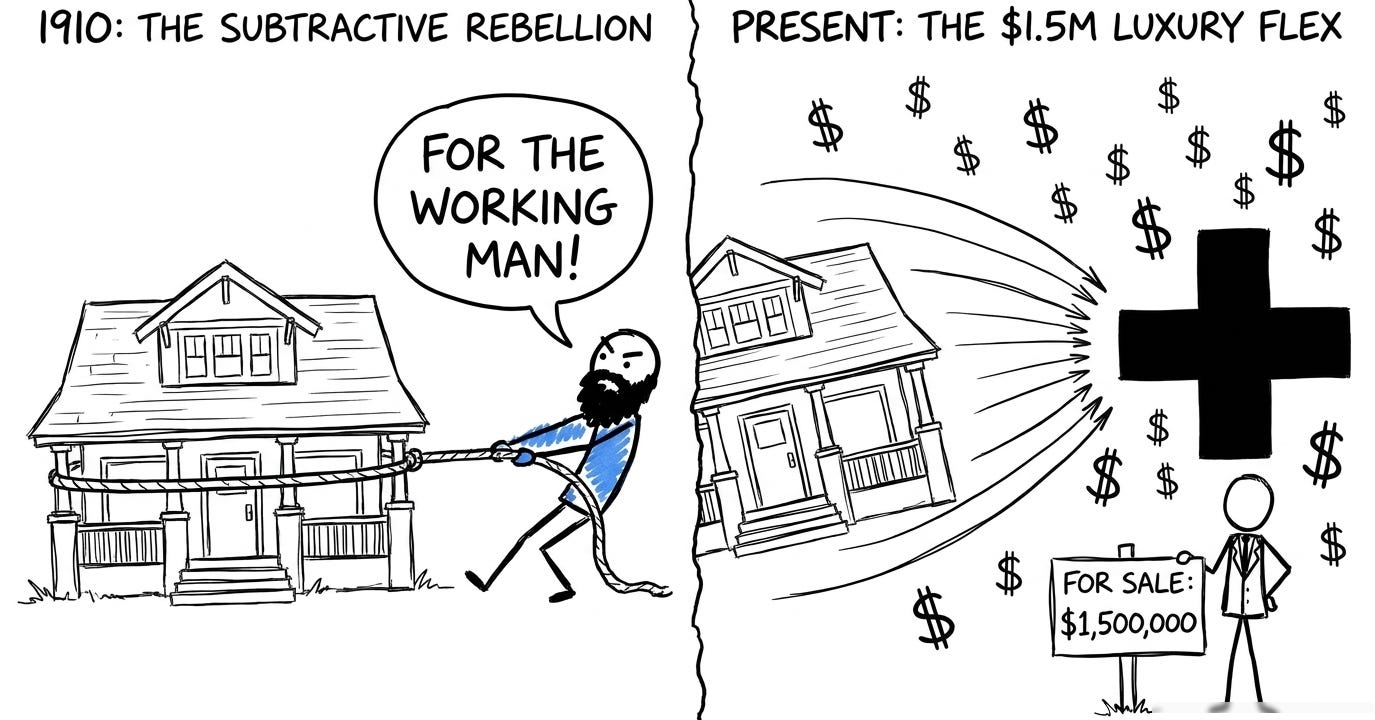
Recently, over morning coffee in the front sitting room of my mother’s 1910 Craftsman home, the conversation turned to the skyrocketing property values in her historic neighborhood.
My mother has long been an anchor in the local historical preservation community, serving on the board and as chair of the Collin County History Museum for years now.
In short, she’s in the “know” about the history of virtually every historical structure in the area as well as all the colorful characters who’ve passed through Collin County over the last 150 years—Clyde Barrow and Bonnie Parker, Jesse and Frank James, to name just a few.
If Hollywood has produced a movie about them and they intersected local history, my mother has guided a tour or written an article about every one of them.
As we chatted, I scanned the room and admired the uncompromising quality and simplicity of the signature Craftsman style.
The morning sun filtered through the wavy, cylinder-glass “bubble panes” and fell onto the thick, quarter-sawn oak trim.
The discussion naturally led my thoughts to William Morris, the founding father of the Arts and Crafts movement and the inspiration for the very room we were sitting in.
Morris is well noted for his contributions to architecture, literature, and high-end wallpaper.
Yet he is far less remembered for his late-19th-century ethos of radical subtraction—a fierce backlash against Victorian industrial maximalism and the frantic accumulation of status symbols.
Looking around the room while considering the rapidly advancing neighborhood home values, I could see that Morris’s vision of subtractive minimalism had been eaten alive by the modern machinery of addition.
Morris dreamed of making honest, beautiful design accessible to everyone—a radical working-class strike against British industrialism.
Instead, the market hunted his vision down, skinned it, and turned it into the ultimate luxury status symbol.
A Communist Blueprint for the Luxury Home
William Morris was no armchair decorator with dreams of his own show on HGTV. He was an absolutist—an aesthetic revolutionary waging war against Victorian mass production, which he felt was robbing labor of its joy.
He looked out and saw a suffocating ecosystem of heavy velvet, fake machine-stamped tin, and a thick film of coal soot.
Demanding whitewashed plaster, natural light, and functional utility, he laid down twelve words that read less like design advice and more like an eviction notice served to assembly-line art : “
“Have nothing in your houses that you do not know to be useful, or believe to be beautiful.
Morris read Karl Marx’s Das Kapital in French, openly identified as a communist, and co-founded the Socialist League alongside Marx’s daughter, Eleanor.
Through our modern lens, we view communism through its 20th-century expressions—brutal totalitarian states and mass starvations.
But in Morris’s time, the movement was rooted in its formative ideals: human dignity and the joy of un-alienated labor.
At Merton Abbey Mills, his forearms were stained deep indigo blue to the elbows, stubbornly reviving medieval vegetable dyes to free workers from assembly-line drudgery.
And then the trap of the market was sprung.
The Addition Machine of Morris’s era went to work. As it turned out, the hand-carved joinery and woodblock printing used for his famous wallpapers and textiles were beautiful, yet prohibitively labor-intensive.
It took skilled craftsmen days to manually align and stamp a pattern hundreds of times—a task an industrial press could perform in seconds.
And so naturally, the only people who could afford his work were the very industrial tycoons he sought to overthrow.
Morris erupted into fits of rage, famously decrying that his life was spent “catering to the swinish luxury of the rich.”
The Premium Subtraction Trap
Fast-forward 115 years to my mother’s sitting room.
In 1910, these Craftsman homes were built for working-class families out of local lumber—simple, functional dwellings built for ordinary life (a couple of doors down sits a house erected straight from a Sears kit).
Today, that same neighborhood carries listings easily exceeding a million dollars.
This is a classic maneuver of the Addition Machine.
First, it wears us to exhaustion with relentless noise and the never-ending pursuit of consumer goods. And then it monetizes the subtraction of all the orchestrated chaos.
The modern obsession with the “minimalist” aesthetic provides a great example.
Minimalism takes our desperate desire for quiet and solitude, paints the drywall limewash beige, moves $8,000 white-oak tables into the dining room, and sells us the idea of “simplicity” at a 400 percent markup.
And finally, to relieve us of all the stress created by our non-stressful living environment, it sells us a lifetime subscription to calming meditation apps for $399.
Paying top dollar for the aesthetic of less isn’t stepping out of the system—it’s just sliding down a calmer, more expensive chute.
Hunters of Unvarnished Truth
At first glance, bringing William Morris into the room with Thomas à Kempis—the 15th-century monk whose Imitation of Christ serves as the focus of our 52-week experiment—seems like an impossible pairing: a Victorian communist artist in London and a medieval Augustinian in a Dutch cloister.
But strip away the centuries, and you see that both men were hunting the exact same elusive ideal: unvarnished truth.
Morris sought it in the physical world, waging war against Victorian counterfeits—fake wood graining, machine-stamped tin pretending to be stone, and cheap chemical dyes. He wanted honest oak, honest joinery, and objects that refused to lie.
À Kempis sought that same honesty in the interior life, warning against the spiritual counterfeits of intellectual vanity and performative piety. Both men recognized that when a culture fills its spaces with fake representations, it corrupts the human spirit.
Where they diverged was in where that truth resides. Morris believed you could craft truth out of timber, dye, and glass. But à Kempis knew the harder reality.
The Monk’s Text Fragment
Five hundred years before William Morris raged over his indigo vats, Thomas à Kempis picked up his quill in a Dutch cloister near Zwolle and diagnosed the exact root of our aesthetic idolatry:
“Happy is he whom truth itself teaches, not by figures and passing words, but as it is in itself... He to whom the Eternal Word speaks is delivered from many opinions.” — Thomas à Kempis, The Imitation of Christ (Book 1, Chapter 3)
Morris thought he could express truth through the reformation of physical objects—by trading machine-made art for honest oak, and coal-tar dyes for indigo.
À Kempis understood a deeper truth.
He intuitively knew that physical objects and hand-crafted interior spaces—even the most authentically beautiful and artisan-created—are merely “figures and passing words.”
The machinery of addition loves consumption—especially when it’s cloaked in the high ideals of minimalism, craftsmanship, and artistic integrity.
Most of all, it loves a high-ticket invoice.
But as à Kempis warned, you cannot buy subtraction at an artisanal design boutique, nor can you secure it by filling a room with old-growth reclaimed timbers.
True subtraction must be lived quietly, invisibly, inside the un-engineered chambers of the heart.
The Active Subtraction Directive: The Un-Curated Corner
This brings us to our assignment for the week ahead: an audit of where we have been purchasing the performance of simplicity.
Let’s ask ourselves whether we are truly seeking silence, or merely another well-crafted status symbol.
The Audit: Identify one space, shelf, or surface in your daily life where you have been staging “minimalism”—arranging aesthetic clutter, buying expensive unbranded items, or curating a scene to signal to visitors (or your own ego) how grounded and unmaterialistic you are.
The Cut: Strip that space down to its bare, unglamorous utility. Remove the curated props, kill the deliberate accent lighting, and refuse to let the space perform for anyone.
The Reflection: Let that corner exist in un-photographed obscurity. Notice the brief twitch of vanity when you realize no one is coming to admire your restraint.
True simplicity is not an aesthetic brand, and it won’t be found in a minimalist design catalog. As à Kempis reminded us, peace is granted to the one whom Truth itself teaches.
It is the quiet, un-monetized baseline that was waiting beneath your feet the entire time.
Cut the performance.
Keep the heart.
Let it be.
To support this independent space or bring the clarity of subtraction to your own project’s philosophy, visit our foundation page.