

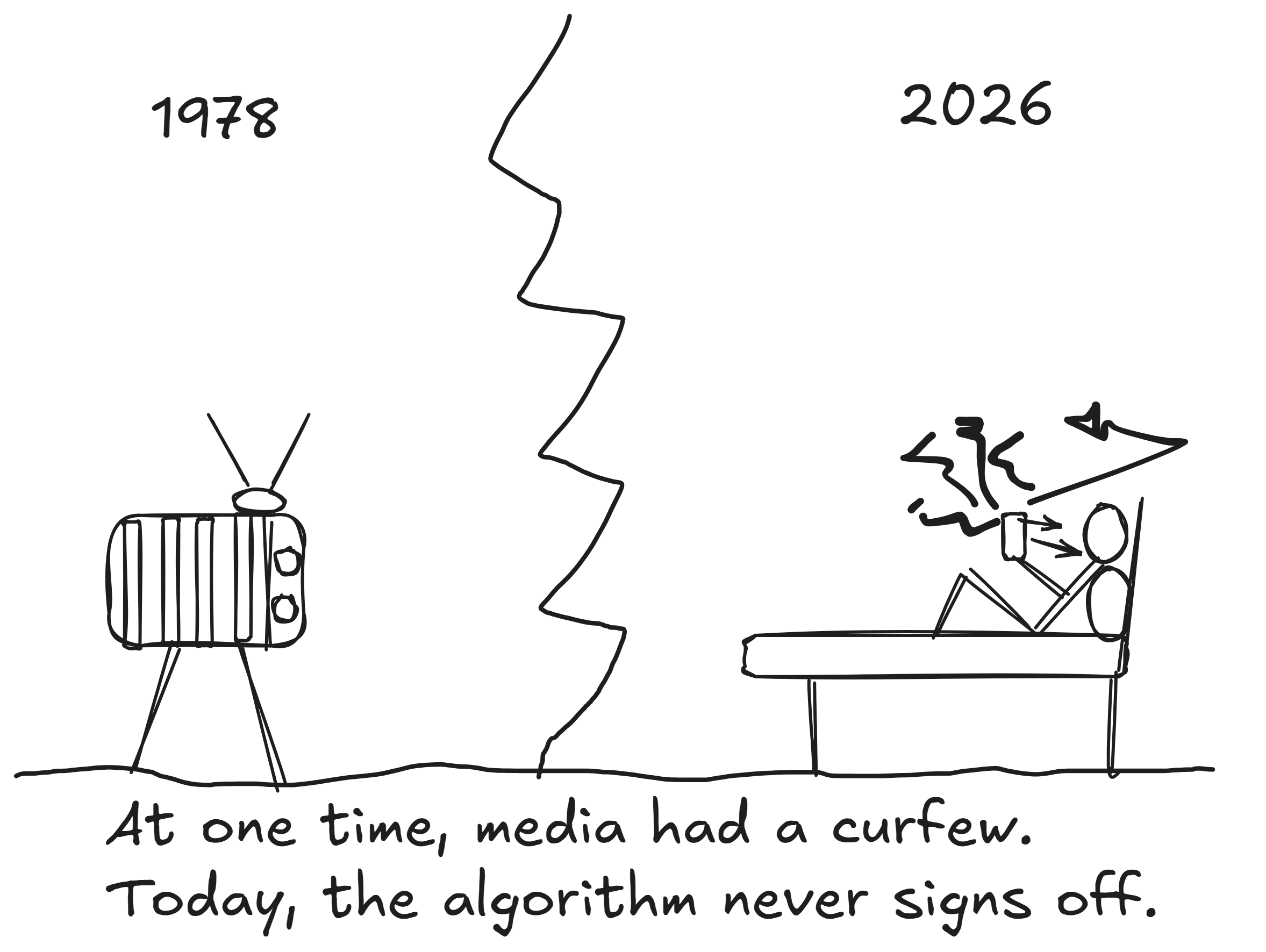
Welcome to The Subtraction Machine and installment #7 of our year-long modernization, dissection, and weekly exploration of Thomas à Kempis’s 15th-century Christian classic, The Imitation of Christ.
(New to this daring experiment? Read the prologue and rules of engagement here.)
Fall Saturday evenings in the late 1970s belonged to a golden era in the time-worn mind of this traveler.
Summer evenings were different, of course. In the summer, my parents allowed me to wring the last straggling but beautiful light out of the day—playing spotlight with the neighborhood kids, searching for tarantulas, and hurling one last football down Northwood Drive to the awaiting arms of a friend.
But fall, spring, and the school-year Saturday nights unfolded in a generally expected and greatly anticipated manner.
First, it was supper, and then off to the bath. A quick one, because I had a very specific agenda with my parents’ stamp of approval.
All in the Family came first. Archie Bunker and his culturally insensitive observations provided the opening act. I liked the show—who didn’t?—even if I didn’t grasp the broader societal references at eight years old. For me, it was simply a warm-up for my absolute favorite shows getting teed up in the CBS lineup.
Next was The Jeffersons or MASH, depending on the season. Either one was a smash hit with me. Who didn’t love George and Weezie? And in all honesty, I think my somewhat acerbic, sometimes jaundiced internal monologue came at least partly from Hawkeye Pierce and the rest of the 4077th MASH unit.
Next in the rotation was The Bob Newhart Show—a droll and brilliant comedic piece I would binge-watch today if I could find a solid block of episodes on streaming. By the time Bob and Suzanne Pleshette were wrapping things up in their twin beds and getting ready to turn off the lamps, I could smell them baking in the oven:
Pepperidge Farm fruit turnovers.
My favorites were the cherry ones, though I don’t ever remember turning down the apple version of baked pastry delight. My eight-year-old cognitive conditioning told me this turn of events meant the entire family was about to assemble for the most memorable family event of the week.
The Carol Burnett Show. Harvey Korman, Carol herself, Tim Conway, Vicki Lawrence, Lyle Waggoner—I loved every single skit. To an eight-year-old, Tim Conway seemed like the undisputed star of the show. I don’t remember a single skit that didn’t have me still laughing hours later as I giggled myself to sleep.
And the fruit turnover? By some miracle of childhood self-control, I managed to prolong its consumption for at least half the show.
My personal trick was peeling the flaky pastry layers back one by one, slowly, deliberately, almost meditatively working my way through each of them.
By the time Carol was dramatically descending the staircase wearing an entire set of green drapes as a dress, I had reached the bottom layer of pastry and Saturday evening nirvana.
As the curtains fell on the show, I knew the curtains on the evening were about to fall, too.
Next up was the 10:00 p.m. local news. We flipped over to ABC for that, because Channel 8 was the clear, undisputed choice in the Dallas-Fort Worth market during that era.
I was always allowed to stay up through the weather forecast—the middle segment. And if I was persuasive and plaintive enough, I made it all the way to the last segment: sports, which was all I cared about anyway.
Then it was a quick brushing of the teeth and off to bed. We had church in the morning, and I could already picture my friends and me in the Sunday school hallway, gleefully recounting the TV-land adventures from the night before.
Look closely at what made that evening holy: it had edges.
Media in 1978 was bounded. It had a beginning, a middle, and a definitive, un-negotiable end.
After the sports segment wrapped and the local news anchor signed off, the station played the National Anthem over grainy footage of jet fighters, the screen dissolved into a high-frequency test pattern and white static, and the living room went dark.
The medium itself commanded: It is over. Go to sleep. Silence was built right into the architecture.
The Modern Bounding-Box Failure
Contrast that 1978 living room with the glowing slab resting on your nightstand right now.
The Addition Machine has taken the bounded media of our youth and stripped away every test pattern, every national anthem, and every white-noise sign-off.
The glowing rectangle in your pocket never goes dark. It does not respect the curfew of the soul.
Instead, it offers a 24/7 infinite stream of chatter—podcasts, cable news hot takes, group chat debates, X/Twitter arguments, and endless commentary.
Sixty-year-olds and twenty-year-olds alike sit propped up against pillows at 11:30 p.m., pecking at the glass, trapped in a perpetual loop of digital noise.
We don’t just consume the chatter; we feel compelled to participate in it. We post our opinions, fire off our reactions, and register our world-changing opinions on every passing event under the sun—and then wonder why we wake up at 6:00 a.m. feeling spiritually exhausted, anxious, and “ill at ease.”
Six hundred years ago, long before television lineups, satellite feeds, or mobile notifications, a medieval monk picked up his quill in an Augustinian cloister and diagnosed this exact human sickness.
The Monk’s Text Fragment
In Book 1, Chapter 10 of The Imitation of Christ, titled Avoiding Idle Talk, Thomas à Kempis laid out the precise spiritual physics of why we fill every quiet gap with noise:
“Shun the tumult of men as much as you can, for the discussion of worldly affairs is a great hindrance, even though it be transformed with simple intention. For we are quickly defiled and captivated by vanity.
Often I could wish that I had remained silent, and that I had not been among men. Why are we so fond of talking and gossiping when we so seldom return to silence without a wounded conscience?
The reason we are so fond of talking is that we seek consolation from one another by such discourse, and we desire to lighten our hearts, overburdened by various thoughts. And we love to talk and think of those things which we like very much, or which we dislike exceedingly.”
— Thomas à Kempis, The Imitation of Christ (Book 1, Chapter 10)
Again, let’s put the monk’s instructions under the modern microscope.
Why are we so addicted to digital chatter? Why do we scroll late-night comment sections and listen to three-hour podcasts while folding laundry?
À Kempis gives us the answer: we are seeking artificial consolation. We use the endless noise of the world to flee interior quiet.
When our hearts are “overburdened by various thoughts,” sitting alone in a quiet room feels terrifying. So we plug into the stream. We surround ourselves with “idle talk”—debating things we like very much or dislike exceedingly—as a cheap, synthetic buffer against our own soul’s silence.
And what is the result? À Kempis calls it: a wounded conscience.
Every time we indulge in superfluous noise, we don’t find peace. We return to silence with a fragmented mind, a depleted spirit, and a low-grade internal disquiet. The Addition Machine promised consolation, but delivered only spiritual exhaustion.
The Active Subtraction Directive: Re-Engaging the TV Test Pattern
This brings us to our collective assignment for the week ahead—an intentional, high-friction sabotage of the 24/7 noise machine. For the next seven days, you are going to restore the 1978 test pattern to your own life.
The Scope: Declare a total moratorium on late-night digital chatter and unprompted commentary for seven consecutive days.
The Mechanics: At 10:00 p.m. every evening (or 30 minutes before your bedtime), enforce a hard sign-off. Turn off the television, banish the smartphone to another room, and turn off the podcast feeds. If the twitchy urge arrives to post a comment, fire off a hot take, or check late-night sports scores or news feeds—stop. Recognize it for what à Kempis called it: a desperate search for idle consolation.
The Result: Let the living room go dark. Let the quiet static settle over your mind. You will discover that the world continues to spin without your commentary, and that true peace is not found at the bottom of an infinite feed. It is found on the un-engineered, quiet ground that was sitting beneath your feet all along.
Reclaim the evening sign-off.
Let the test pattern do its work.
Let it be.
To support this independent space or bring the clarity of subtraction to your own project’s philosophy, visit our foundation page.