

Welcome to Installment #3 of our year-long excavation of Thomas à Kempis’s 15th-century monastic masterpiece, The Imitation of Christ.
If you are new to this series or need to refresh yourself on the project, you can read the Prologue to the series here.
The good monk à Kempis was a fascinating, devout figure who spent decades penning his spiritual reflections onto parchment within an Augustinian cell—all set against a backdrop of the tragedy and turmoil that engulfed his era.
He wrote while secondary and tertiary waves of the Black Death decimated Western Europe—all as the Hundred Years’ War raged across western Europe and a bitter Papal schism cleaved Christendom cleanly in half.
Yet, from the epicenter of a world on fire, à Kempis chose to write about radical interior quiet, humility, and intentional submission before God.
Today, our week-by-week serial turns to Book 1, Chapter 4: “Prudence in Action.”
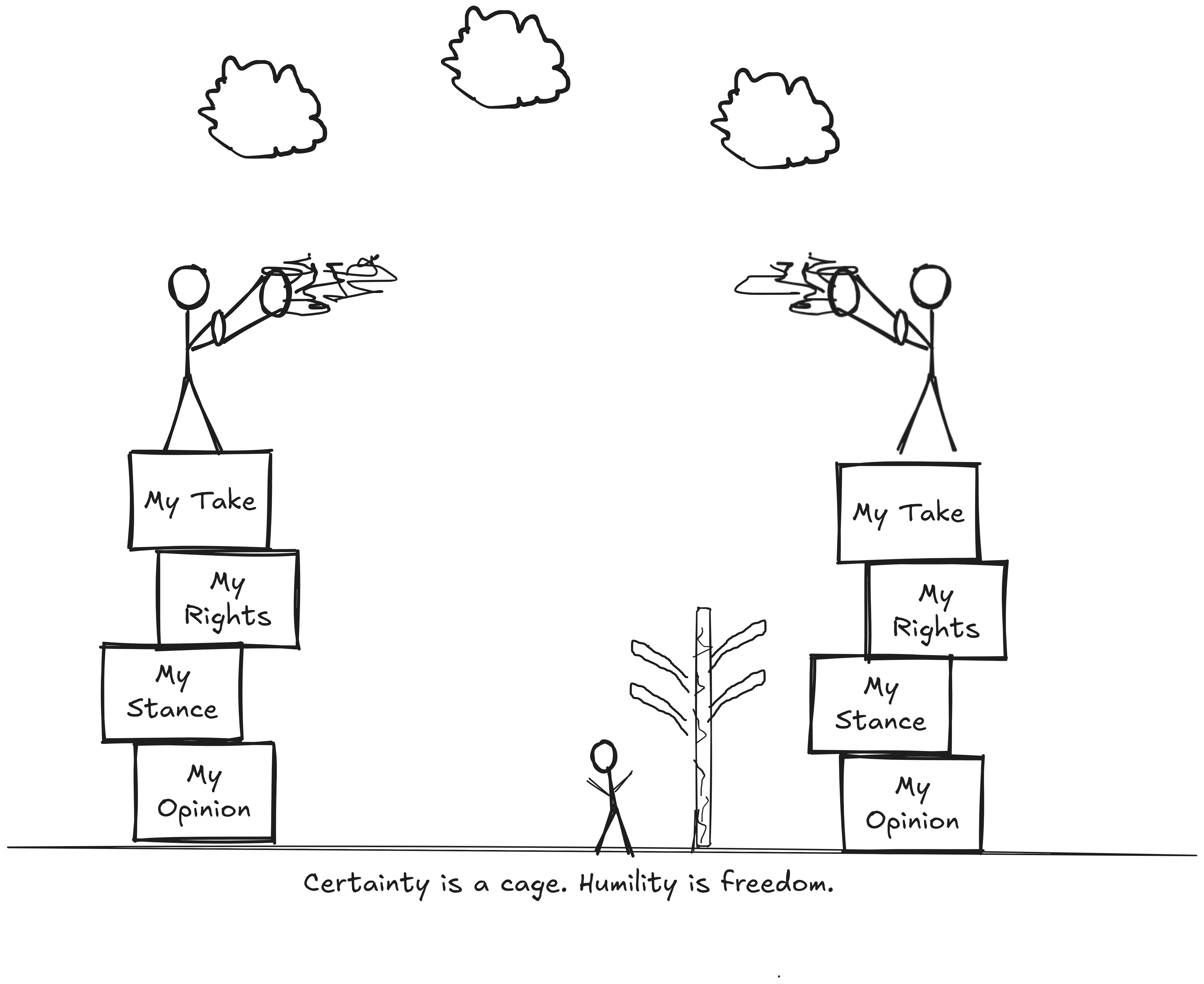
Specifically, we are putting the monk’s dire warning against vanity and our natural human obsession with being “right” under the modern microscope—what à Kempis diagnoses as “the spiritual trap of clinging obstinately to one’s opinion.”
If we were to pull the old Augustinian from his quiet cloister and seat him directly in front of our glowing glass screens, he wouldn’t need a single lesson in social media or smart phone 101 to understand what we’ve built.
He would look straight past the silicon and scrolling videos, peer into our frantic, defensive eyes, and instantly recognize the ancient architecture of the trap.
He would identify the disease—a culture engineered for infinitesimal division, identity warfare, and hyper-fragmentation.
Millions of humans cordoned off into algorithmic factions, all bellowing into glowing rectangles, all convinced of their absolute, unyielding righteousness.
Before we examine how the Addition Machine monetizes that endless friction, allow me a brief, nostalgic side trip: Jackson Browne’s 1978 classic, Running on Empty—a timeless exploration of speed, perspective, and the blur of passing years.
The Architecture of Being Right
Before the Addition Machine monetized my political, spiritual and cultural certainties, it demanded my attention to the written word.
In 1985, I was sixteen years old, and Jackson Browne was my high priest. To my teenage mind, Browne was the ultimate message bearer of sensitivity and self-reflection—running shirt off, running blind, chasing some poetic phantom into the sun.
At sixteen, I didn’t care about deep theological dogmas or complex metaphysical frameworks. But I possessed a fierce, unyielding certainty about art.
As a budding writer, I was entirely convinced I knew the precise shades of language, how sentences ought to be assembled, and—more importantly—how everyone else was getting it wrong.
By twenty-five, my need to be right had been educated, hired, credentialed, and given a corporate desk at Texas Instruments.
I found myself sitting in a required continuing-education seminar taught by a Harvard professor—the esteemed, undisputed authority on the exacting science of direct marketing.
We were standing right on the precipice of all content going digital, yet he was still lecturing us on optimizing the engagement metrics of paper direct-mail cards.
Long before that room, in the early 1960s, David Ogilvy—the father of modern advertising—had already begun preaching the strict gospel of measurement and direct response.
Before Ogilvy, advertising was mostly “brand awareness,” a gentle, pervasive bid for premium real estate in the consumer’s mind.
Ogilvy demanded math. He demanded tracking.
He insisted that every ad produce a measurable, testable human reaction. The science was already in place.
The Addition Machine was simply waiting for the birthing of the digital infrastructure to unleash its dark diagnostics of our every click, scroll and tap.
When the world flipped digital, those crude paper metrics exploded into real-time behavioral tracking.
Every human thought, every micro-interaction, every modern micro-habit became a living, breathing organism of its own—something to be indexed, measured, interpreted, and acted upon to create deterministic channels of monetization.
Looking back today from age fifty-seven, I see the whole game for what it was.
The sixteen-year-old critic defending his syntax, the 1960s ad prophet scrutinizing the housewife’s coupon clips, and the twenty-five-year-old marketer optimizing direct mail were all feeding the exact same engine.
Today, I no longer care to hold the hill. The need to win the argument, prove my superiority, or defend my ideological turf has evaporated, replaced by the quiet, internal space of questions and more questions.
The Text Fragment: The Monk’s Sieve
Now, let’s turn down the blaring volume on the day. Look closely at the monk’s simple, uncompromising instruction written six centuries ago from an Augustinian cell:
“Not to act rashly or to cling obstinately to one’s opinion is great wisdom; nor is it wise to believe everything people say or to spread abroad the gossip one has heard.
Take counsel with a wise and conscientious man, and seek to be instructed by your betters rather than to follow your own inventions. A good life makes a man wise in God’s eyes and experienced in many things.”
— Thomas à Kempis, The Imitation of Christ (Book 1, Chapter 4)
The Division Engine
When Thomas à Kempis warned us “not to cling obstinately to one’s opinion,” he was addressing the ancient spiritual disease of human pride. But today, the Addition Machine has weaponized that flaw into an infinite and extremely lucrative business model.
Division is profitable; unity is not. A peaceful, unified population standing together on a shared bedrock generates zero ad impressions, zero outrage clicks, zero campaign contributions, and zero engagement metrics.
The news feeds of the modern internet do not sell content; they monetize moral panic.
If an algorithm presents your neighbor as a decent human being who simply holds a different view on municipal bonds, you close the app and go water your lawn.
The Machine makes zero revenue on a peaceful citizen.
But if the algorithm convinces you that your neighbor’s vote makes them evil incarnate, your nervous system instantly floods with cortisol and dread.
You stay on the screen for three hours, refreshing the feed to track the enemy’s next move. You share the outrage bait, amplify the talebearers, and retreat deeper into your ideological fortress.
That is the cold, commercial logic of the Addition Machine: peace generates no engagement, but demonization is an eternal revenue stream.
When à Kempis tells us not to believe every talebearer, not to yield to every impulse, and not to cling obstinately to our opinions, he isn’t offering polite ethical advice. He is handing us a wire-cutter to snip our dogmatic leash.
The Weekly Assignment: The Opinion Fast
Your assignment—our assignment—for the week ahead strikes directly at both ideological idolatry and our individual and collective outrage.
For the next seven days, let us refrain from the entanglements of offering opinions or engaging in divisive positions.
The Trigger: When a controversial headline, political argument, or cultural hot-take enters your orbit—whether at the dinner table, in the breakroom, or online—you will actively choose not to chime in.
The Mechanics: Let the urge to correct someone, defend your position, or prove your intelligence sit quietly. Then, let it naturally evaporate from your mind and heart. Your ego wants to be heard, but let’s give it the day off.
The Result: We will discover that the world continues to spin without our commentary, and that stepping out of the argument is the only way to protect the quiet sanctuary of the soul.
Hold the questions. Let the noise pass by.
And as we concluded last week’s segment, let it be.
To support this independent space or bring the clarity of subtraction to your own project’s philosophy, visit our foundation page.