

Welcome to The Subtraction Machine and installment #11 of our year-long modernization, dissection, and weekly exploration of Thomas à Kempis’s 15th-century Christian classic, The Imitation of Christ.
(New to this daring experiment? Read the prologue and rules of engagement here.)
Crimes and Confessions of a 19-year-old Sports Writer
When I was nineteen years old and a college journalism student sitting press-row at Baylor University’s Ferrell Center in Waco, Texas, I had convictions about writing—very strong ideas that bordered on artistic vanity.
I loved Thomas Wolfe’s Look Homeward, Angel, and I felt like a permanent resident of Faulkner’s fictional Yoknapatawpha County.
Different writers, but both captured my budding writer’s imagination with words—and plenty of them.
I counted Faulkner’s words in one particularly powerful sentence from Absalom, Absalom!
There were one hundred and sixteen of them. A glorious parade of modifiers, descriptors, and clauses, marching in grand procession behind commas and semicolons.
A much better effort, I thought, than Hemingway, who typically clocked in at fifteen words max on any given sentence. I guess he was too busy thinking about running from the bulls in Spain.
And so, following these maximalist giants as a holy template, I embarked on my story lead for a school basketball game I was covering.
I still wince when I think of it today:
“The Lady Bears were the latest in a long line of victims to fall prey to the relentless attack of the Lady Longhorns, losing 91-36 in a disappointing and devastating fashion before a crowd of 2,456 Saturday night at the Ferrell Center.”
I think you get the idea. I had managed to turn a routine blowout into a bloated, tragic epic.
Which leads us directly to one of the most staunch, uncompromising advocates of minimalist writing: Dr. William Strunk Jr.
His legendary decree to “omit needless words” was the exact opposite of my Faulknerian delusions, and I can assure you that he would have salivated at the idea of taking his red pen to my budding inner Grantland Rice.
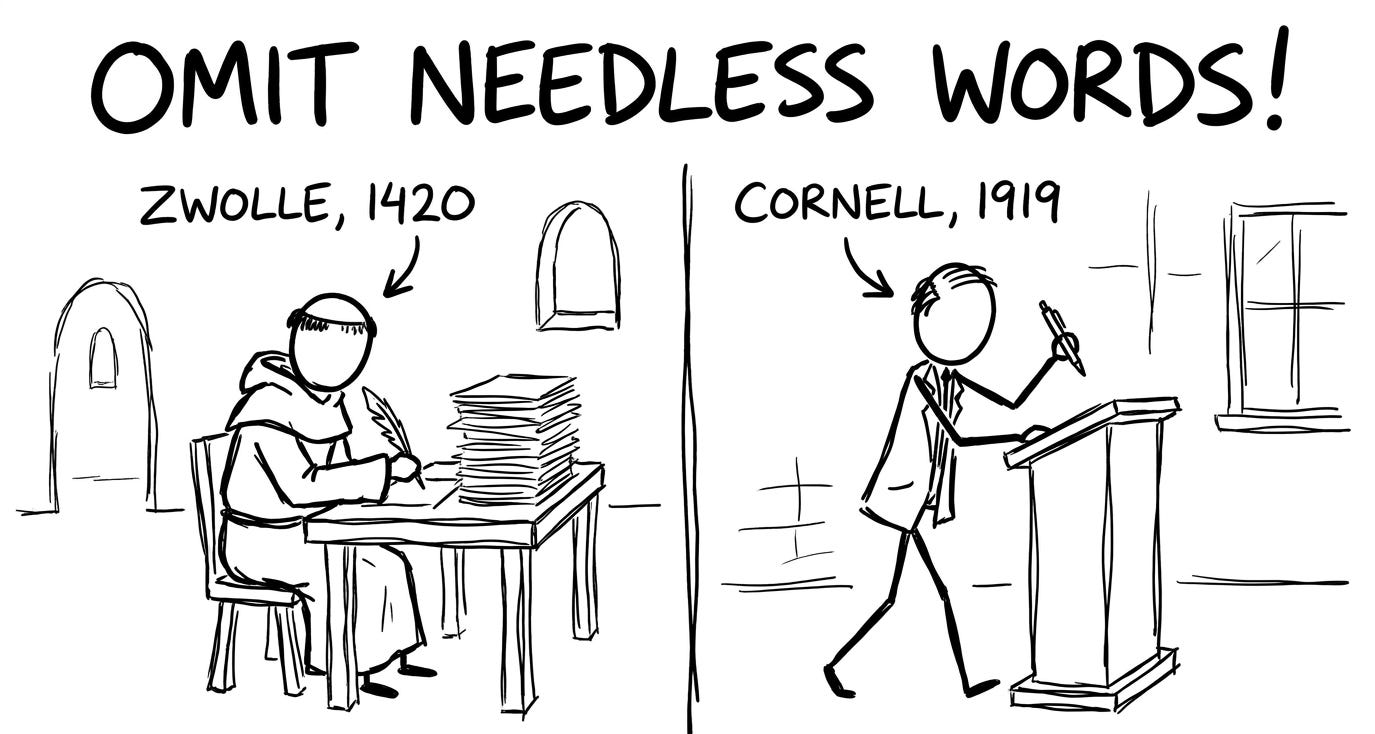
Cornell, 1919: The Gospel of Subtraction
Seventy-some years before I committed those crimes in Waco against syntax—and all decent and imperturbable readers—Dr. William Strunk Jr. was railing against excess from his classroom podium.
No doubt there were many gifted students in those hallowed classrooms, but sitting in the front row was a young man named Elwyn Brooks White.
E.B. White would go on after Cornell to write Charlotte’s Web, spend forty-nine years at The New Yorker, and publish over 1,800 essays and dispatches.
He became one of the cleanest, most muscular prose stylists in the history of the English language.
And he built that entire career on a single, rhythmic battle cry he learned in Strunk’s office:
“Omit needless words! Omit needless words! Omit needless words!”
Strunk didn’t view editing as mere stylistic polish or schoolmarm “correct sentence construction.”
He viewed the concept as a mechanical and moral discipline. In his self-published manual, The Elements of Style, Strunk put it plainly:
“A sentence should contain no unnecessary words, a paragraph no unnecessary sentences, for the same reason that a drawing should have no unnecessary lines and a machine no unnecessary parts. This requires not that the writer make all his sentences short, or that he avoid all detail and treat his subjects only in outline, but that every word tell.”
Every word tell. Not posture. Not impress. Not perform. Tell.
A 15th-Century Cry for Omission
Five hundred years before Strunk paced the classroom floor at Cornell, Thomas à Kempis diagnosed the exact same disease from a quiet Dutch monastery near Zwolle:
“Happy is he whom truth itself teaches, not by figures and passing words, but as it is in itself... He to whom the Eternal Word speaks is delivered from many opinions.”
— Thomas à Kempis, The Imitation of Christ (Book 1, Chapter 3)
À Kempis understood that an over-decorated, bloated vocabulary is often a defense mechanism against interior quiet.
The Addition Machine is this site’s symbol for “more.” More systems, more layers, more noise. Although he never named it, the Machine makes the perfect arch-nemesis for Dr. Strunk and his gospel of reduction.
Addition thrives on “figures and passing words”—the high-status corporate buzzwords (synergy, leverage, paradigm, bandwidth, optimization, curation) that flood our feeds and inbox threads.
They act as linguistic camouflage. They signal intellectual sophistication while masking empty thinking.
They are a triple soy caramel macchiato when a cup of strong black coffee works fine.
The Yeoman Words
Strunk and à Kempis offer us a radical, counter-cultural exit: The Yeoman Words.
In medieval England, yeomen were the backbone of society. They were free men who sat in the cultural space between the peasants and the landed noblemen—bringing loyalty, skill, and independence to the realm.
Yeoman words are the field hands of the English language: build, bread, house, work, grace, grief, choice, current.
They aren’t afraid of hard work. They carry their own weight, and they don’t posture. They seek no applause, impress no audience, and advance no hidden agenda.
They perform the honest, unglamorous work of conveying meaning.
Why are these Yeoman, hard-working words as critical today as they were to Thomas à Kempis and Dr. William Strunk?
Because when you audit your prose, or your spoken word, and strip away the pompous padding and high-status buzzwords, a quiet flash of insecurity usually follows.
You realize how much you were relying on the jargon to sound important or feel a part of the room. But from this discomfort sprouts meaning and clarity.
With practice, you’ll recognize added words and phrases for what they are: unnecessary layers that obscure the truth.
They are the lies the Machine feeds you to keep you confused, impressed, or buying.
Don’t fall for it.
The Active Subtraction Directive
And this brings us to our collective weekly assignment—our Active Subtraction Directive.
The Audit: Scan your recent emails, posts, or written work today. Identify three “high-status” buzzwords or trendy jargon terms you routinely rely on to sound authoritative.
The Cut: Replace them with plain, direct yeoman nouns and verbs. Strip out the verbal or written padding until the sentence has no unnecessary parts.
The Reflection: Sit with the brief flash of vulnerability that occurs when you strip away the high-status jargon—and notice the quiet, unvarnished truth that takes its place.
Slash the jargon.
Name the thing.
Let it be.
To support this independent space or bring the clarity of subtraction to your own project’s philosophy, visit our foundation page.