

In 1988, Nike launched a three-word campaign that tore through the culture and the advertising industry with the same unstoppable, brute force as its spokesman, Bo Jackson, running through an opposing defensive line.
The phrase was a masterstroke. “Just Do It” rocketed the company’s market share in athletic shoes from 18 percent to 43 percent in a single decade.
But culturally, it is no mere relic of an era remembered for parachute pants and mediocre radio hits.
The slogan was rapidly adopted as the ultimate mantra of personal empowerment across every discipline of modern life.
Mental health, women’s empowerment, corporate coaching, personal development—you name it. The self-affirming ethos of “Just Do It” became our cultural tagline.
We got this. You are in control. Just do it!
The rest of the advertising industry didn’t just take notice; they experienced a revelation.
They realized that if you flatter the human ego enough—if you tell the consumer they are the absolute, autonomous authors of their own reality—they will buy whatever you are selling.
Selling the illusion of limitless potential—strictly conditional upon the purchase of their branded gear—became the undisputed blueprint for modern consumerism.
The ad executives became a secular priesthood handing down new automated worldviews. And we bought it wholesale.
The Well-Dressed Automaton
Today, we walk around like sleepwalking robots, draping their branding campaigns across our chests and carrying their idioms with us like our ubiquitous water bottles, never once stopping to consider the true meaning of the scripts we are espousing.
It is time to wake up. It is time to run the liturgy of the label through a philosophical sieve.
You can trace the architecture of this specific demolition directly to Jack Cottrell.
A brilliant writer and reformed theologian who departed from us in 2022, Cottrell authored a mammoth structural work titled, What The Bible Says About God The Ruler.
The book caught my constantly roving eye primarily because Cottrell brilliantly maps out the heavy, foundational crisis of human identity:
What is free will? Does it even exist? And what is the basis for moral action—any action—when we operate within a deterministic framework defined by automated algorithms?
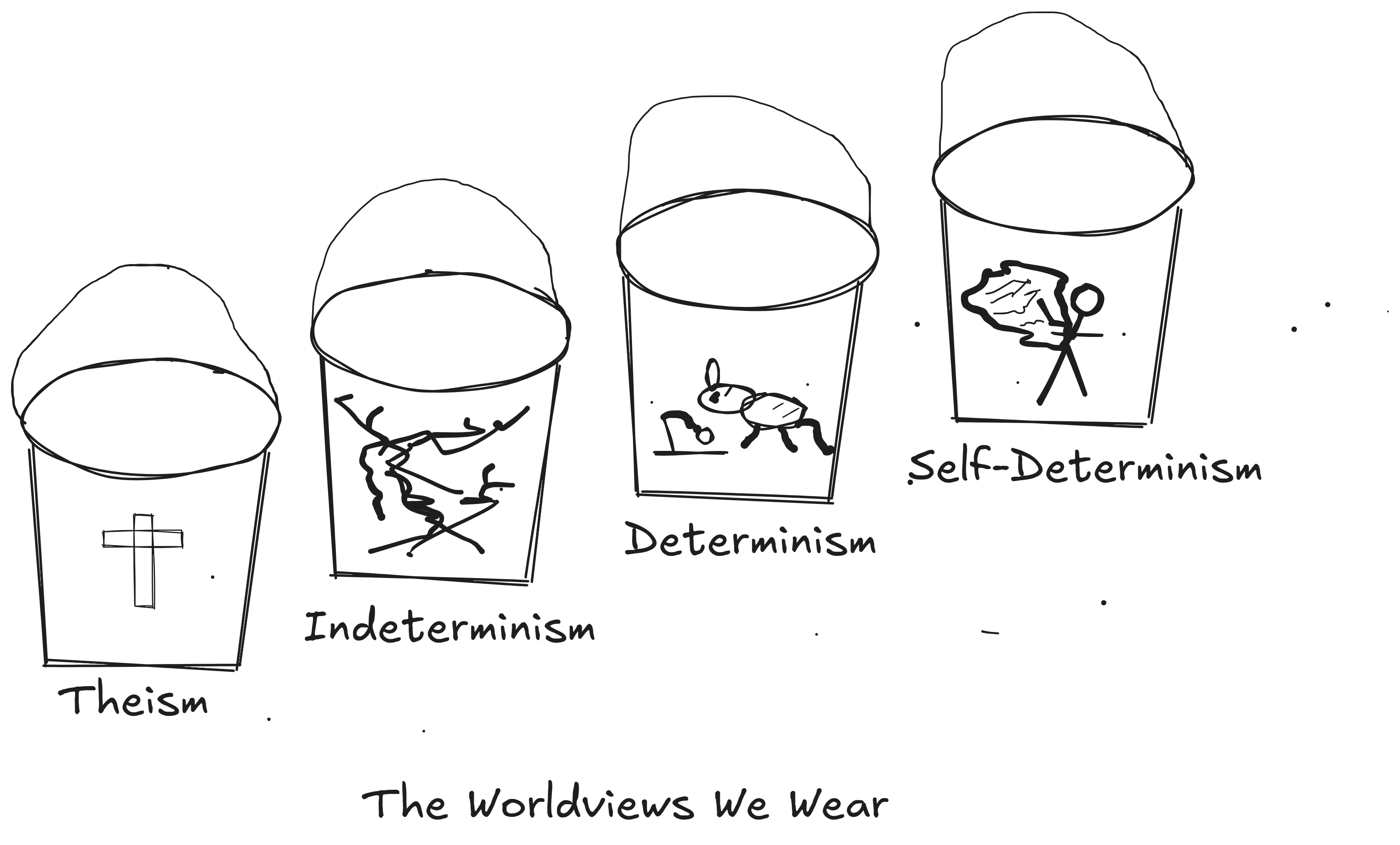
To answer those questions, Cottrell builds a framework of distinct metaphysical buckets.
And when we hold the modern slogans we wear every single day up to his mirror, the illusion of our independence shatters completely.
I’d say don’t be alarmed, but you should be. Terrified is a more apt word.
These scripts aren’t relegated to graphic t-shirts and corporate self-help seminars. They are everywhere.
They are embedded in your favorite streaming series, the viral memes you chuckle at surreptitiously at work when the boss isn’t looking, and even in the pews of your church.
Let us not delay. Here are the four foundational buckets we are placing under the cultural microscope:
Theism — The absolute baseline. The belief that an intelligent Creator put the universe in motion, presides over it, and maintains complete sovereign control.
Indeterminism — The Cult of Chaos. An architecture of sheer chance and unpredictable drift, favored heavily by the ancient Greeks and modern materialists
Determinism — The automated slide. The terrifying proposition that you and I control absolutely nothing, that free will is an illusion, and that moral action exists in a vacuum because every outcome is already pre-programmed
Self-Determinism — The myth of the self-made deity. This is the hyper-individualistic “Just Do It” ethos neatly bow-tied into a convenient, easy-to-carry worldview. It is the holy water of the advertising industry, utilized to sell untold numbers of sports replenishment drinks..
Now, let us look at some real-time examples of these shockingly vital worldviews in action.
1. Theism (The Blueprint)
This is the ancient metaphysical recipe. It is the unyielding reality that an intelligent, supreme Creator governs the cosmos with an absolute blueprint.
History is not an accidental roll of the dice; it is a structured landscape of divine will and objective purpose.
You see this worldview expressed in prevalent, everyday idioms like “Everything happens for a reason”, “It’s in God’s hands” or “Let go and Let God.”
But the modern commercial world treats this bucket with profound embarrassment.
Why?
Because the Addition Machine cannot monetize a soul that answers to a higher, non-transactional authority.
The architects of the attention economy need you to buy their solutions, and you won’t do that if you already trust the Architect of the universe.
2. Indeterminism (The Cult of Chaos)
If Theism is the blueprint, Indeterminism is the active demolition of the building. This is an architecture of sheer chance and unpredictable drift.
The secular priesthood sells this to us constantly. It is the theology of the extreme sports matrix screaming, “Unleash the Beast,” or the generational battle cry of “YOLO (You Only Live Once)”.
It is the Las Vegas tourism board handing down the liturgical chant: “What Happens in Vegas, Stays in Vegas.”
It is Sprite commanding you to abandon rational constraint and “Obey Your Thirst.”
These are not just edgy marketing campaigns; they function as unexamined philosophical scripts. They trick the consumer into believing that absolute chaos is the same thing as personal freedom.
But it is a trap.
If the cosmos is merely an accidental roll of the dice, personal accountability completely vanishes.
The human traveler is left with only one logical trajectory: ignore moral weight, maximize raw consumption, and chase the next dopamine spike before the lights go out.
3. Determinism (The Soft-Tech God)
Here is the terrifying proposition that you and I control absolutely nothing.
Determinism is the unyielding assertion that every human choice, action, preference, and internal reflex is strictly bound by an unbreakable chain of prior causes.
You wear this script every time you open a screen. It is Spotify curating “Your Daily Mix: Made For You” and Netflix whispering “Because You Watched...”.
It is the biological determinism sold by 23andMe reminding you that “It’s in your DNA,” or eHarmony reducing the mystery of human romance to a “29-Dimension Scientific Matchmaking Algorithm.”
It is also hidden in our YouTube algorithmic feeds. Take, for example, our modern obsession with ancient Greek Stoicism.
Not only is the feed itself an automated overlord of deterministic behavior, but so is the philosophy it peddles.
Stoicism dictates that we are metaphorical “dogs chained to the moving cart of a pre-determined destiny.”
It preaches that the absolute best, and only moral action we can take, is to keep a stiff upper lip and trot alongside a vehicle we have absolutely no control over.
This is the Addition Machine operating as an automated deity.
4. Self-Determinism (The Self-Made Deity)
This brings us to the granddaddy of modern cultural touchstones.
True self-determinism is simply the capacity of an individual to exercise internal willpower to direct their life within responsible boundaries.
In other words, we can’t control droughts, hurricanes, and Halley’s Comet, but we can lose 30 pounds, run a marathon, and earn that new job title if we apply enough sheer, relentless effort.
But consumer capitalism has warped this into a hyper-individualistic myth of absolute, unbounded libertarian freedom.
We know the holy texts of this movement. It is Nike’s “Just Do It”.
It is Adidas preaching the absolute hubris of “Impossible is Nothing.”
It is Levi’s hijacking ancient spiritual cadence to command us to “Go Forth.”
It is The North Face demanding that we “Never Stop Exploring”—locking the human creature into an exhausting, endless treadmill of self-actualization.
These slogans flatter the consumer by telling them that their environment, their legacy traps, and divine boundaries are completely irrelevant. And Hollywood serves as the ultimate megaphone for this bucket, selling the myth across a brilliant, deceptive spectrum:
The Therapeutic Myth: Look at a beloved cultural staple like Fried Green Tomatoes. It presents the deeply consumer-friendly, feel-good version of self-determinism.
Kathy Bates’ character embarks on an ultimate journey of self-actualization, adopting an empowered alter-ego to smash through her repressed life. It tells the viewer that absolute autonomy is simply a matter of finding your inner roar.
The Idealized Myth: We see its ultimate triumph in The Shawshank Redemption, where Andy Dufresne spends 20 years quietly chipping away at a prison wall with a rock hammer to achieve autonomous liberation.
He famously declares to his friend Red, “Hope is a good thing.” But the secular script conveniently ignores the terrifying follow-up question: Hope in what?
In this bucket, the self is the only God there is. It preaches that sheer, unyielding internal willpower can conquer any systemic cage, masking a cold, closed-loop theology behind cinematic sentimentality.
The Catastrophic Reality: But then we reach Fight Club. This is what actually happens when the unyielding walls of reality refuse to bend to our naked will.
The protagonist is a man crushed by the impossible pressure of constant material pursuit and self-actualization.
Because the script demands he be the autonomous god of his own reality, the impossible weight of that responsibility literally fractures his mind, sending him violently into the chaotic drift of Indeterminism.
Hollywood dramatizes this fracture, but the Addition Machine packages the exact same impossible pressure as everyday motivation.
Look closely at the Gatorade campaign: “Is It In You?”
That slogan perfectly illustrates the absolute terror of this bucket.
By ignoring our structural limits and our need for a Savior, this worldview places 100 percent of the executive pressure directly onto the individual’s back.
It implies that any failure is a lack of your own internal moral fiber. It demands that you become the autonomous architect of your reality, which inevitably induces catastrophic spiritual anxiety and exhaustion.
The Existential Cliff
When you thread these four buckets together, you are brought directly to the edge of the ultimate philosophical cliff.
If you mindlessly swallow the deterministic or chaotic scripts printed on the modern landscape, morality completely vaporizes.
If our paths are merely pre-programmed by Silicon Valley behavioral engines, or if life is just a chaotic series of uncaused accidents, the steering wheel is an absolute illusion.
You lose the objective baseline required to distinguish between pure depravity and absolute self-sacrificing holiness.
Under the cold rules of either the deterministic cage or the chaotic void, a life devoted to washing the wounds of the dying in Calcutta and a life devoted to industrial genocide are both just meaningless expressions of biological drift.
Adolf Hitler, Mother Teresa, and your relentlessly positive yoga instructor Katie—in a universe built without a sovereign blueprint, they are all tragically equal.
Yet, as we navigate modern life, we wear these terrifying metaphysical considerations like a light spring windbreaker.
We are left walking through the world as sleepwalking robots.
The Active Subtraction Directive: Building the Cognitive Sieve
Whether it is the manufactured “empowerment” of an ad slogan, the subtle theology of a cinematic script, or the algorithmic programming of our daily feeds, we carry the machine’s mantras with us like the ever-present water bottles of modern life.
We swallow their worldview drop by drop.
It is time to stop carrying their water.
Your assignment for the week ahead is to build a personal cognitive sieve. You are going to actively identify the liturgy of the Addition Machine.
Look at the branding on your own chest in the mirror. Look at the fifteen-second commercial on your screen. Look at the bumper sticker on the car in front of you in traffic.
Do not let the message pass through unexamined. Stop and call it by its true name.
Is it selling you the Chaos Liturgy of Indeterminism? Is it flattering you with the algorithmic cage of Determinism?
Or is it burdening you with the hyper-individualistic myth of the Self-Made Deity?
Filter the noise through your own uncompromised perception of reality. Demand to know the architecture of the message before you let it into your mind.
To support this independent space or bring the clarity of subtraction to your own project’s philosophy, visit our foundation page.