

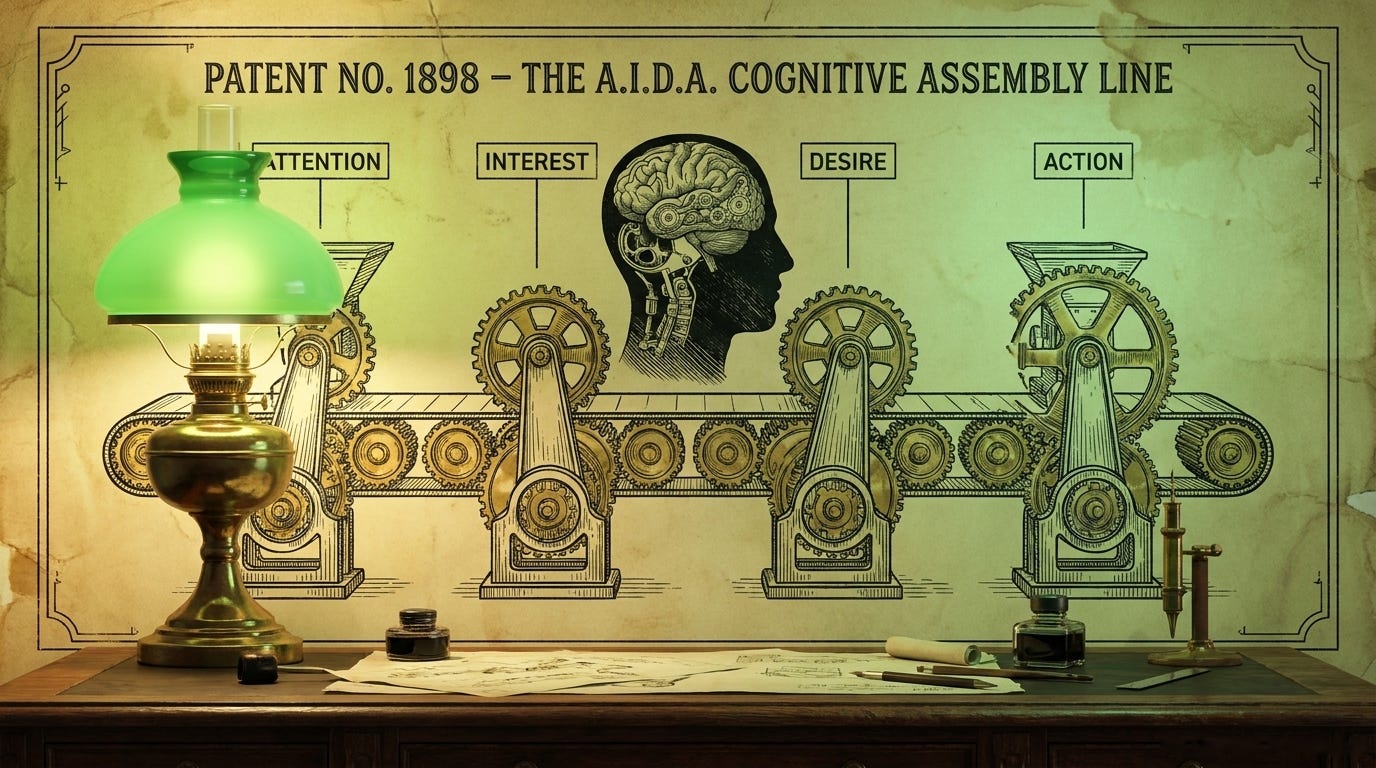
Welcome to The Subtraction Machine. This is Chapter 1 of The Maternity Ward of Desire—a 130-year forensic autopsy tracing how advertising pioneers, behaviorist labs, and Silicon Valley software architects systematically automated human choice.
From the first paper sketch of the purchasing process in 1898 to the ultra-persuasive smart device in your pocket, the series explores the ultimate question:
Whose life are you really living?
(If you’re joining us mid-stream, start with The Maternity Ward of Desire: Prologue —a chilling entry point into a 130-year metaphysical horror story that will leave you mystified, vigilant, and wondering which choices you really own.)
Invention Becomes the Mother of Necessity
The year was 1898. The city, Philadelphia.
Elias St. Elmo Lewis was in a bind. Two years earlier, he’d launched his dream—a pioneering firm in the nascent, unproven advertising industry—and now he needed money. Badly.
Right outside his Chestnut Street window, the world was teeming with the triumphs of industrial manufacturing. Safety bicycles, packaged cereal, mechanical typewriters, adding machines, cast-iron sewing machines.
The public was spellbound by the novelty of it all, but there was a fatal flaw in the business process: ordinary folks couldn’t connect the innovation with an actual need in their own lives.
A rapid-fire, foot-pedaled sewing machine was a marvel, sure. But who needed one when a needle and thread had worked just fine for generations?
Industry was turning out products far faster than human culture could generate organic desire.
The old proverb claimed that necessity is the mother of invention. Lewis understood the unvarnished reality: if his firm was going to survive the coming winter, he had to invert the paradigm.
Invention would need to become the mother of necessity.
And in the quiet glow of his gas lamp, amidst these dire straits, an idea coalesced.
Elias St. Elmo Lewis was about to become the first delivery technician in the Maternity Ward of Desire.
He was about to build the first industrial assembly line for the engineering, control, and manipulation of the most sacred asset a human being possesses:
Their own free will.
Construction Begins: The Assembly Line of Desire
With a freezing winter approaching and an agency on the brink, Lewis knew that time and action were essential.
But the ad man was holding a good hand: he moved in social circles with the brightest engineering minds of the industrial age.
One man in particular—Frederick Winslow Taylor—had been pioneering groundbreaking process efficiency ideas in the steel-making industry. Lewis was about to modify these exact principles to transform the human purchasing process.
Taylor was the toast of the industrial world in the late 1800s, compiling his techniques and theories into a unified system of “Scientific Management.”
Taylor didn’t tour the factory floor and tell men to work harder. Instead, he took a scientific approach to labor.
He timed every motion a worker made and designed custom shovels so that whatever load a laborer lifted—whether heavy iron ore or light rice coal—he was always moving a precise payload of 21.5 pounds.
The improvements were staggering. The shoveling modifications alone reduced the same amount of work from 500 men to 140. And the average payload per day increased from 16 to 59 tons per man, per day.
To put it mildly, Taylor was obsessed with scientific process optimization. Elias St. Elmo Lewis took notice and recorded copious notes.
Under his gas lamp on Chestnut Street, he set out to leverage these breakthroughs to mechanize the entire arc of human choice—from first glance to final purchase.
The Epiphany: Advertising as a Mental Processing Plant
Even before his Philadelphia breakthrough, Lewis was intently focused on the buyer’s mental sequence, constantly arguing that advertising should educate the consumer on a product’s benefits rather than merely listing inventory, prices and store location.
But his new flash of insight would prove revolutionary.
In the short term, it became the exact value proposition he pitched to his clients to keep his firm solvent through the lean winter of 1898.
But on a deeper level, Lewis had established the foundational blueprint for manipulating human choice.
He had no way of knowing it at the time, but his four-stage mental process flow would become the master template for media that didn’t yet exist: radio, television, and the glowing screens in our palms.
How to Sell an Engineer in Four Easy Steps
His prospective clients were leaders in industry—engineers, iron masters, and corporate managers. They had little tolerance for artistic ad copy, clever slogans, or what they reviled as “P.T. Barnum snake oil.”
The industrial leaders Lewis sought to woo thought in terms of boiler pressure, gear ratios, and scrap rates. Being analytical, they demanded measurable, reliable, and repeatable returns on their capital investments—and this included advertising.
To sell to an engineer, Lewis knew he had to think like an engineer.
They didn’t want creativity; they wanted a machine, one that produced results. They wanted an assembly line that produced paying customers with the same cold, mathematical predictability with which their foundries produced cast-iron stoves.
Lewis set out to engineer a highly efficient process that would reliably deliver what his clients demanded above all else—paying customers.
He dipped his fountain pen, put ink to paper under the soft green glow of his gas lamp off Chestnut Street and wrote three capital letters:
A — I — D
Attention. Interest. Desire.
A short time later, as he put the formula to work on real client accounts, Lewis recognized a fatal flaw in the first pass of his blueprint: Desire was critical, but it was useless without action.
Without that final element of customer action, the transaction remained unfinished—and money was left on the table.
A prospect could look at an advertisement for a typewriter or an adding machine, feel the genuine desire to own it—and still walk away without buying.
Human hesitation was a leak in the process.
The customer had to be urged, even commanded to finalize the transaction. And so, to shut the exit hatch on the sale, Lewis added the fourth and final gear: Action.
1898: In the Palm, the Screen, and the Aisle
Take a look at your phone right now. That critical piece of Lewis’s formula hasn’t gone away. It’s built into every push notification, buy button, and endless feed.
Notice the websites you visit daily, especially those selling a subscription, an online course, or a high-ticket item.
Online marketers are savvy enough to hold off on asking for your credit card at the “Attention” stage of the sales process. Instead, they reel you in with a “lead magnet”—typically in the form of a free guide, a checklist, or a “10-Day Transformation” PDF.
They’re steadily, methodically moving you toward Action.
The strategy is simple and universally used: you enter your email address in exchange for the download, and just like that, you’re firmly inside their pipeline.
A series of automated emails follows, methodically priming you for the eventual sale. If you spend any significant time online, you’ll spot this mechanism at work everywhere.
That fourth element—Action—was the only step Lewis’s clients truly cared about. And it was never confined to a single screen, printed page or era.
For over a century, it has been the universal language of extraction across every medium we touch.
Television—it’s Billy Mays roaring at you late at night: “Call now! Order in the next ten minutes and we’ll double your offer free!” Millions of kitchen cabinets now hold unused tubs of OxiClean as a quiet monument to that single Action command.
Marketers call this the “time takeaway.” If you don’t act immediately, you’re led to believe the offer simply vanishes into thin air.
In supermarket aisles and department stores, the same clock is ticking: “Doorbuster Event! 40 Percent Off—Today Only!” The time takeaway has moved onto the sales floor.
And on millions of glowing mobile screens: “Buy Now.” “Add to Cart.” “Download the Free Guide.”
Whether shouted through your late-night TV, festooned across a department store window, or blinking at you in high-intensity blue and green LED lights, every countdown timer, “Order Now” button, or one-click checkout is Elias St. Elmo Lewis whispering in your ear.
He’s closing the door on your chance to hesitate.
If we could magically transport Lewis and his keen mind from 1898 Philadelphia straight into a modern office or coffee shop, what would he see?
Would he be dazzled or confused by our glowing glass slabs—by the sight of an entire room sitting in silence, each face bathed in pale light, locked in a séance with a ghost only they can see?
Given the way he viewed the world, he would intuitively understand: every single person in the room was silently moving through his four-stage cognitive assembly line.
Attention seized. Check.
Interest hooked. The tilted, nodding heads would tell him so.
Desire manufactured. The quickened breathing and dilated pupils. Check.
And finally, Action. The frantic thumbs tapping “Add to Cart” and “Buy Now” buttons would give him all the confirmation he needed.
The decision pathway he sketched in 1898 was working just as planned. It had become the silent, invisible architecture of the world.
Historical accounts paint a picture of Lewis as pragmatic, intensely energetic, authoritative, and guided by an “educator’s mindset.”
He was no villain. He was simply a remarkably perceptive innovator solving a real-world problem—moving a human being from awareness to purchase in one seamless exercise.
In that sense, he was no different from the problem-solvers of our own era.
Whether trying to streamline human-software interfaces, engineer solutions to man-made environmental crises, or optimize global supply chains, modern innovators are all driven by that same fundamental instinct: eliminate a point of friction, strip away resistance, and bring order to chaos.
The Gospel of Zero Friction
Later in his career, as advertising manager for Burroughs Adding Machine and founding president of the organization that became the Association of National Advertisers, Lewis demonstrated genuine empathy.
He pleaded for “the development of the whole man,” warning against treating workers and consumers like unfeeling machine parts.
And yet, he unknowingly set in motion a conveyor belt that would evolve into the pervasive persuasion machines running on our screens today—quietly governing our choices from the grocery aisle to the traffic light to our car insurance rate.
As the evening drew to a close off Chestnut Street in late October 1898, Lewis wiped his pens and filed his notes.
A-I-D-A.
Four simple letters that would change marketing forever, accomplishing what the titans of the Gilded Age never dreamed possible: a clear, repeatable process for turning unpredictable human thought into a tangible business asset.
With that quiet achievement, Elias St. Elmo Lewis stepped into history as the first attending technician on the floor of the Maternity Ward of Desire.
He had constructed the initial delivery table and written the clinical textbook for manufacturing human longing—hidden desires customers didn’t even know they possessed. And those same mechanics are still working to this day.
The Next Shift in the Maternity Ward
Elias St. Elmo Lewis was only the first leg of a multi-generational relay.
As the nineteenth century gave way to the twentieth, Lewis completed his shift and handed the baton to the next wave of behavioral technicians waiting in the dark to build on his foundation:
To John B. Watson, who would strip away human consciousness in favor of raw behavioral stimulus.
To Claude Hopkins, who would map the habit loops of daily ritual and turn toothpaste into a national obsession.
To Edward Bernays, who would marry Freudian psychoanalysis with mass propaganda to engineer human consent.
To B.F. Skinner, who would construct the automated box to condition behavior through variable rewards.
And ultimately, to the persuasive technology labs of Silicon Valley, coding Lewis’s 1898 chute directly into the glowing glass in our palms.
To support this independent space or bring the clarity of subtraction to your own project’s philosophy, visit our foundation page.