

Welcome to The Subtraction Machine and installment #10 of our year-long modernization, dissection, and weekly exploration of Thomas à Kempis’s 15th-century Christian classic, The Imitation of Christ.
(New to this daring experiment? Read the prologue and rules of engagement here.)
A Smooth Takeoff and a Very Bad Disembarkation
American Airlines Flight 726 en route from Dallas-Fort Worth to Philadelphia in October 2004 was predictable.
It was a mid-afternoon takeoff in early fall. As we climbed, the October Texas sky was punctuated by a few cotton-ball cumulus clouds falling away beneath us.
The flight was 80 percent full by rough estimate, and I was fortunate to grab an aisle seat.
I usually relished the view from a window, but my ingrained claustrophobia told me to forgo that pleasure in favor of immediate mobility.
When the middle seat remained empty after boarding, I was thrilled to have the extra elbow room.
Down the aisle, a beaming blonde flight attendant was already making her way toward us to take drink orders. But just as I settled into my good fortune, I felt a gentle tap on my elbow.
There she was: my soon-to-be conversational companion for the remainder of the flight. She had taken the wrong seat during takeoff and was now being ushered by an attendant to her correct assignment—aisle 12, seat B.
I fancy myself a gifted raconteur—back then as I still do today—and so my aisle mate and I opened the volley with the usual menu of topics.
“Is your daughter married? Grandkids? What’s your favorite Tex-Mex restaurant in Fort Worth? Joe T. Garcia’s, of course. And which famous Philly cheesesteak place should I hit first—Geno’s or Pat’s?”
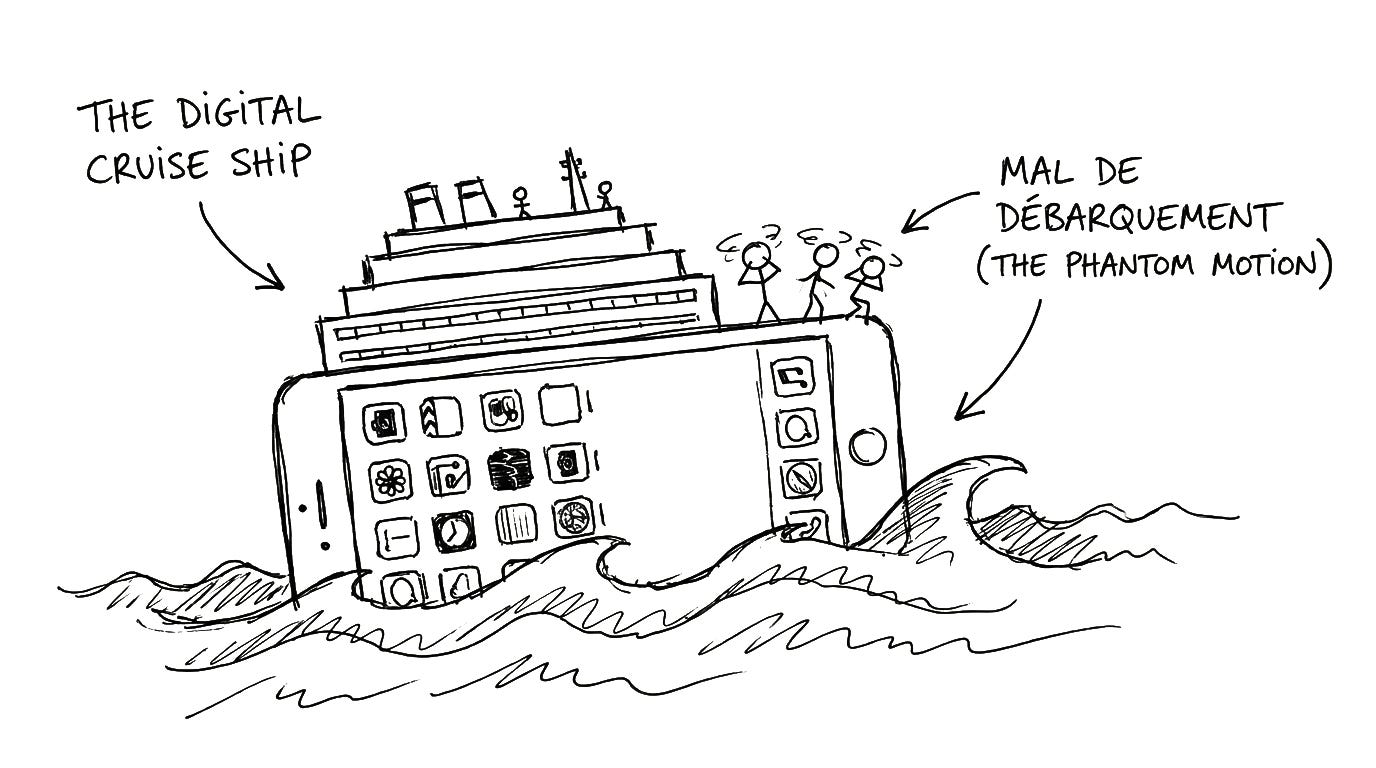
And then she embarked on a tale of a very bad disembarkation. Or as she so eloquently phrased it in the French: mal de débarquement.
Being the gifted raconteur I mentioned earlier, I thought she was telling me she was an arborist, and so I reached for a reply and came out with an observation about incorrect methods of removing bark from a tree.
She quickly corrected me. Ships, she was referring to cruise ships.
The Phantom Motion of the Soul
Jan called it mal de débarquement—literally, the sickness of disembarking. To me, the phrase flowed beautifully, even elegantly off the tongue and past the lips.
But as I soon learned, it held no artful linguistic beauty for this woman.
For ten long years after stepping off a cruise ship and onto solid pavement, her inner ear has steadfastly refused to believe the earth isn't rolling. The land was firm, but her brain kept generating the motion it had been conditioned to expect.
Mal de débarquement is a real but fairly uncommon medical condition that afflicts roughly 150K people in the U.S. alone.
In medical summary, the condition is activated when in motion on a boat or plane.
The brain interprets the motion as the new “normal,” but fails to reset once the victim is back on solid ground.
Jan had suffered from it for more than 10 years now—the result of a surprise birthday cruise her kids had gifted her as a celebration.
As Flight 726 leveled out over Arkansas, her story made a strong and indelible impression on me. But the meaning of it didn’t hit me until years later.
She hadn’t simply given me insights on a life-altering medical condition.
She had handed me a map describing the motion sickness of our collective spiritual restlessness.
The Spiritual Vertigo of the Addition Machine
We spend a great deal of energy on The Subtraction Machine diagnosing the Addition Machine—the world and its perpetual systems of layers and complexity.
We face more metrics, more life optimization, and more noise from the technological systems that generate the bulk of it.
Many times we make a concerted effort to mitigate or escape the noise—turning off the phone, closing the laptop, keeping a journal, making an effort to live more simply and deliberately.
But the world keeps moving. It keeps adding. Our shared spinning orb doesn’t instantly transform into a peaceful planetary retreat.
Instead of serenity, you just feel dizzy.
Your stomach drops. A subtle and unexplainable anxiety sinks into your chest. And then the reason becomes clear to you:
Sitting quietly in a room, with no stream of notifications and electronic calls to action—this is the culprit. It becomes the source of your anxiety, not the cure for it.
The feeling of sanctuary you were seeking suddenly feels more like standing on the tilting deck of a ship caught in a sudden swell.
Most people quickly—and even reasonably—assume this restlessness is proof that removing the device and its stream of alerts doesn’t quite work.
And so how do we solve the problem?
Sometimes with the addition of even more distractions—a better routine, a more highly rated app, another strong cup of fair trade coffee.
Then, we jump into a new podcast, one that better optimizes our lifestyle needs. A fresh news feed, another life project—all to stop the dizziness.
Five hundred years ago, writing from a quiet monastery in the low countries, Thomas à Kempis diagnosed this exact spiritual vertigo in Book One, Chapter XI of The Imitation of Christ:
“When a man seeks his repose in any creature, he soon grows heavy and discontented... Great peace would be ours if we did not busy ourselves with the sayings and deeds of others, and with things which do not concern us. How can he remain long in peace who entangles himself in foreign cares?”
— Thomas à Kempis, The Imitation of Christ (Book 1, Chapter 11-)
À Kempis understood that our internal chaos isn’t caused by the silence. The silence merely exposes the phantom motion.
We’re all passengers on the “cruise ships” of the modern world. We have adapted to the perpetual motion and the never-ending journey to some unnamed destination.
When you spend years riding the hyper-produced, dopamine-rocking experiences of the modern world, your soul adapts to constant motion.
You mistake agitation for purpose and stimulation for life. When you finally step off that vessel and onto solid, unmoving ground, the sudden stillness feels like a crisis.
But the anxiety you feel in quiet solitude isn’t a lack of spiritual progress—it is spiritual mal de débarquement. It is your nervous system begging for the old, familiar movement because it has forgotten what solid ground feels like.
The 7-Day Subtraction Directive: Enduring the Vertigo
The Head (Identify the Phantom Motion):
This week, pay close attention to the exact moment you step into a quiet room, sit down at an un-screened desk, or wait in line without pulling out your phone. Notice the immediate spike of internal disquiet—the sudden, inexplicable urge to check an app, open a fresh tab, or find a podcast. Name it out loud: This is not spiritual failure. This is mal de débarquement.The Heart (Anchor the 10-Minute Baseline):
When the vertigo hits, do not reach for a “floating device” to stop the sway. Do not open a new tab or pick up the phone to soothe the anxiety. Sit in the quiet for ten uninterrupted minutes. Remind yourself that the ground beneath you is firm, and that the dizziness is merely your brain missing the artificial rocking of the Addition Machine.The Foot (Starve the Phantom Motion):
Let the phantom motion burn itself out. As Thomas à Kempis promised, great peace arrives the moment we stop entangling ourselves in foreign cares. When you refuse to feed the internal sway, the inner ear of the soul slowly resets, and solid ground becomes solid ground once again.
Embrace the vertigo.
Stand on solid ground.
Let it be.
To support this independent space or bring the clarity of subtraction to your own project’s philosophy, visit our foundation page.