

Welcome to The Subtraction Machine and installment #6 of our year-long modernization, dissection, and weekly exploration of Thomas à Kempis’s 15th-century Christian classic, The Imitation of Christ.
(New to this daring experiment? Read the prologue and rules of engagement here.)
You know them. They’re easy to spot.
The stylized Hollywood villain ruthlessly raiding corporations only to break them up and sell them off for an unholy fortune. “Greed is good,” they tell us from a penthouse balcony.
Or maybe it’s an elaborate Ponzi scheme designed to bilk retirees out of their hard-won life savings.
These stereotypical celluloid hucksters are written into the scripts to make us feel better about ourselves.
We aren’t raiding companies or gutting pension funds. We’re just hard-working, ordinary folks putting in long hours at the accounting firm, running a plumbing business, or driving Uber on the weekends to make ends meet.
But the truth is, most of us are trapped in the exact same loop of endless acquisition.
It’s the garage stuffed with high-end tools we’ll never touch. The kitchen with more Ninja-branded gadgets than a team of chefs at the French Laundry would know what to do with.
It’s the late-night scroll on Facebook Marketplace, hunting for a deal on something—anything. Amazon has over 25,000 categories, so surely there’s something in there we can’t live without. A new juicer. Compression running shorts. A laser golf rangefinder.
Acquiring the next thing we ‘must have’ is exhausting—and frankly, it never ends. In fact, our algorithmic feeds and the endless expansion of ‘niches’ ensure the cycle never stops.
In Book 1, Chapter 6 of The Imitation of Christ, Thomas à Kempis makes no distinction between Wall Street avarice and suburban micro-acquisition. He doesn’t care about the size of the ledger—he cares about the temperature of the soul.
And his diagnosis is brutal: “When a man desires a thing too much, he at once becomes ill at ease.”
The Monk’s Text Fragment
Six centuries ago, in a quiet, lamp-lit cell, Thomas à Kempis took a quill to sheepskin parchment and diagnosed this very same human restlessness and desire for endless acquisition.
He didn’t have Amazon Prime, Facebook Marketplace, or Ninja air-fryers, but he understood the physics of the human heart better than any modern algorithm.
In Chapter 6 of Book 1, titled Unbridled Affections, he laid out the exact spiritual mechanics of what happens when we let our desires run wild:
“When a man desires a thing too much, he at once becomes ill at ease. A proud and avaricious man never rests, whereas he who is poor and humble of heart lives in a world of peace.
An unmortified man is quickly tempted and overcome in small, trifling evils; his spirit is weak, in a measure carnal and inclined to sensual things; he can hardly abstain from earthly desires. Hence it makes him sad to forego them; he is quick to anger if reproved.
Yet if he satisfies his desires, remorse of conscience overwhelms him because he followed his passions and they did not lead to the peace he sought.
True peace of heart, then, is found in resisting passions, not in satisfying them. There is no peace in the carnal man, in the man given to vain attractions, but there is peace in the fervent and spiritual man.”
— Thomas à Kempis, The Imitation of Christ (Book 1, Chapter 6)
Look closely at the trap the wise monk describes.
When you chase an unordered desire, you become “ill at ease”—that baseline feeling of low-grade anxiety that tells you happiness is just one purchase away.
But here is the tragic loop: even when you satisfy the desire, “remorse of conscience overwhelms him because he followed his passions and they did not lead to the peace he sought.”
It’s the dopamine hangover. The box arrives on the porch, the tape is ripped open, the new tool or gadget is placed on the shelf, and thirty minutes later, the quiet hollowness returns.
The Addition Machine promised satisfaction, but delivered only secondary remorse. And the endless desire to do it all again.
The Confession: Notes From a Spiritual Seeker
I’m a subtractionist at heart. I hate to use the word “ascetic” because that sounds high-minded and haughty, quite frankly.
But in my heart, I’ve always felt a deep disdain for what I see as the needless collection of “things”—whatever that thing might be.
Kitchen gadgets, cigar humidifiers, Native American pottery curated to demonstrate one’s cultural sensitivity.
The list is endless.
But I have an admission to make. I have my own sickness.
No, I’m not obsessed with gaining material objects. In fact, I’ve often honestly expressed that I’d like to leave this world with nothing more than what can fit in my backpack.
What I am obsessed with, however, is the constant—and often needless—accumulation of ideas, and the tools that support the collection and organization of those ideas.
I collect information of every variety—from tectonic plate shifting to the rise of organized labor.
I collect software. I hoard note-taking systems, theological frameworks, and digital tools—telling myself that if I just find the right stack, I’ll finally create a frictionless interface with the Divine.
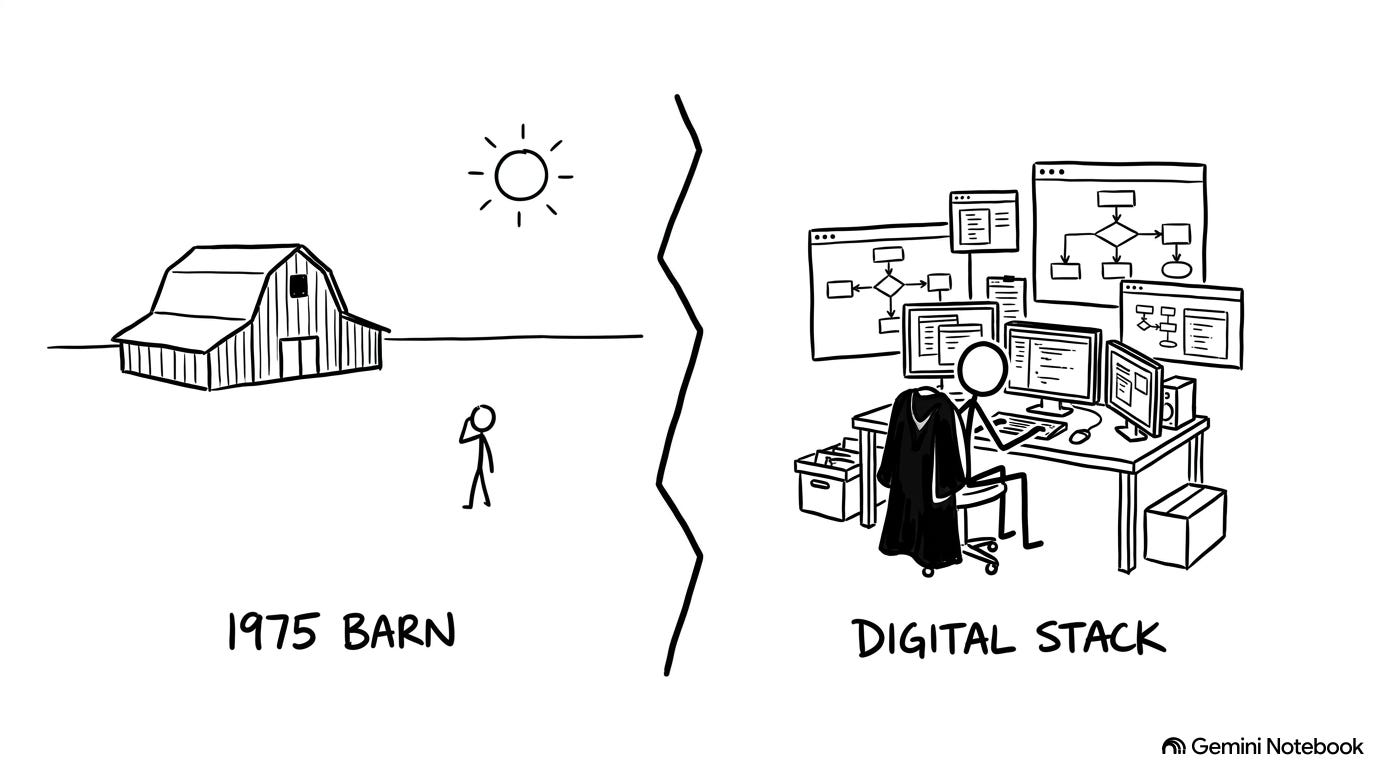
In my very first essay on The Subtraction Machine, I wrote about an abandoned, rotting barn in an open Texas field.
I was only six years old, viewing it from half a mile away across the plowed blackland clay. But even then—framed in solitary silence against a perfect azure sky—I intuitively knew it was a living embodiment of unadorned grace.
It represented pure subtraction from the signal interference of worldly systems.
And yet, here I am, clogging my digital horizon with tools to analyze the silence instead of just sitting in it.
It is the exact same unbridled desire, dressed up in a monastic robe.
I stand as guilty as the next person—the one collecting antique salt shakers and pepper grinders.
I fell for the refined chute. The Addition Machine realized I didn’t care about status cars or kitchen appliances, so it painted its traps in intellectual colors.
It sold me the tools about the journey rather than letting me simply walk the road. It tricked me into spiritual hoarding.
The Active Subtraction Directive: The Acquisition Fast
This brings us to our collective assignment for the week ahead—a highly intentional throttling of our own often insatiable appetite for acquisition. For the next seven days, we are going to practice The Acquisition Fast.
The Scope: For seven days, declare a total moratorium on non-essential acquisitions—both material and digital. (Baseline groceries and routine maintenance supplies are allowed; dopamine-driven collecting is not.) No new Amazon orders, no Facebook Marketplace browsing, no buying books, and no downloading new software, note-taking apps, or productivity stacks.
The Mechanics: When the familiar itch arrives—the urge to buy, download, or collect something to soothe a Tuesday afternoon restlessness—stop. Recognize it for what à Kempis called it: an unbridled desire making you “ill at ease.” Instead of feeding the itch, sit with the discomfort for ten minutes. Let the urge evaporate on its own baseline.
The Result: You will discover that true peace is not found at the bottom of a shipping box or inside an optimized software stack. It is found on the un-engineered, un-monetized ground that was sitting beneath your feet the whole time.
Step off the slide. Delete the cart.
Protect the sanctity of the soul.
Let it be.
To support this independent space or bring the clarity of subtraction to your own project’s philosophy, visit our foundation page.