

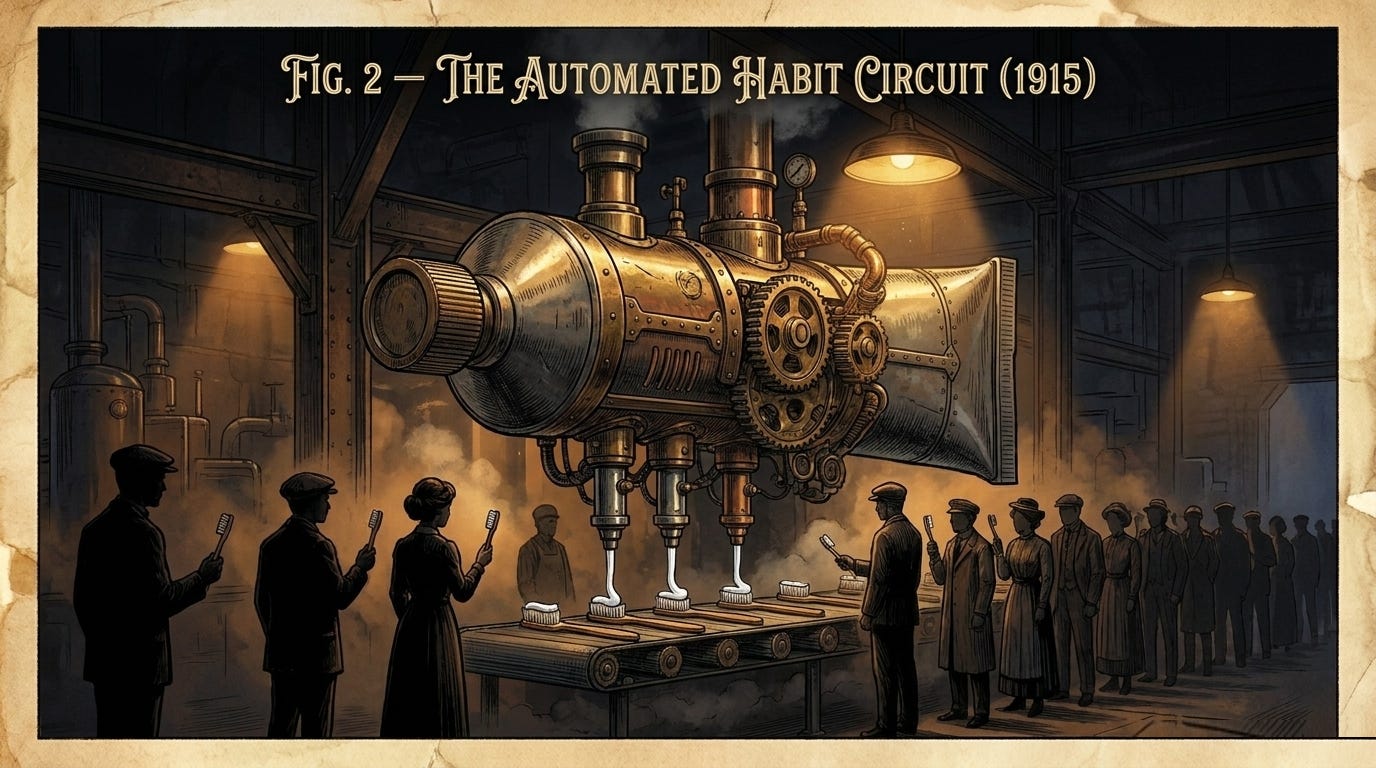
Welcome to The Subtraction Machine. This is Chapter 2 of The Maternity Ward of Desire—a 130-year forensic autopsy tracing how advertising pioneers, behaviorist labs, and Silicon Valley software architects systematically automated human choice.
From the first paper sketch of the purchasing process in 1898 to the ultra-persuasive smart device in your pocket, the series explores the ultimate question:
Whose life are you really living?
(If you’re joining us mid-stream, start with The Maternity Ward of Desire: Prologue —a chilling entry point into a 130-year metaphysical horror story that will leave you mystified, vigilant, and wondering which choices you really own.)
Part 2 of The Maternity Ward of Desire series.
How Claude Hopkins Put Human Desire on Repeat
We noted in the prologue to this series that the 130-year journey of refining the process of steering human decision-making was not an organized cabal.
There were no dark villains plotting in smoke-filled rooms to systematically put humans in shackles, nor was there a grand design for eliminating our free will.
In fact, most of them were only looking for a way to improve on an existing process—to lower friction in the purchase path, eliminate waste, and move products languishing in the warehouse.
Elias St. Elmo Lewis—whose story we told in Chapter 1—was simply a highly perceptive innovator faced with a very real business problem. Personally, the ad man needed money badly to keep his industrial clients happy and his business afloat.
And his clients faced massive challenges of their own. Warehouses were bulging with millions of identical, factory-churned goods—soaps, cereals, razor blades, and textiles—but human buying habits remained slow, local, and embedded.
Capital was suffocating under the weight of its own unsold inventory. Lewis set out to alleviate his own financial pressure by bringing his clients a repeatable, measurable process for solving theirs.
His Attention–Interest–Desire–Action (AIDA) framework was the engine designed to synchronize consumer demand with the relentless speed of the assembly line.
In Lewis’s mind, he wasn’t building a trap for the customer—he was an educator bringing order to chaos. He genuinely believed that a clear, repeatable process actually helped confused consumers navigate the noise of the modern market.
Customers Included—No Assembly Required
Most of the technicians, innovators, and marketers who built onto the work of Elias St. Elmo Lewis never met the man, and many were likely unfamiliar with his AIDA framework by name.
They didn’t need to consult or conspire with Lewis because they could see the practical effects of his work all around them in the marketplace.
As an analogy, think of millions upon millions of raindrops falling from the sky onto a vast plain.
They never consult one another on their journey to the ocean; they simply follow the slope of the terrain, merging into creeks and then rushing rivers.
They are all responding to the same irresistible call of gravity.
Elias St. Elmo Lewis felt that same gravity under the green glass shade of his Philadelphia lamp in 1898.
The force driving him forward was the inescapable pull of an industrial market drowning in surplus and desperate for an effective way to move goods.
He responded by installing the psychological framework for guiding a stranger’s mind down a linear, four-stage marketing funnel: Attention, Interest, Desire, Action.
Lewis’s AIDA formulation was a clarion call to American industry, transforming marketing from a passive announcement into an engineered pipeline.
But the system had one glaring hitch: it only captured human attention, desire, and action once. To generate a second sale, the merchant had to restart the entire persuasion process from scratch.
Twenty years after Lewis defined the architecture of choice and drew the sketches of desire, a young technician began adding lubrication to the machinery.
Claude C. Hopkins, a workaholic ad man operating in 1920s Chicago, realized that requiring a customer to consciously decide to buy your product every month was a fatal flaw in the process.
A customer who has to think is a customer who might hesitate, shop around, or opt out of the purchase pathway entirely. Price, budget, a competitor’s pitch—there were a dozen reasons a human being might leave the marketing funnel once, or step off forever.
Lewis had done impressive work in building the delivery table—the mechanism for human desire.
Now, Hopkins was about to install a permanent, revolving door on the transaction.
The Mental Machinery Goes Underground
In the gritty, “time-is-money” industrial environment of 1920s Chicago, human deliberation was an operational bug. It created friction—a dangerous delay in the pipeline running from factory floor to retail counter.
To Claude Hopkins, every second a consumer spent thinking was a defect in the system.
And like Elias St. Elmo Lewis before him, Hopkins drew inspiration from the intellectual current of his day: John B. Watson and the rising gospel of behaviorism.
Watson took the experimental research of Ivan Pavlov—who proved that biological reflexes in dogs could be tied to arbitrary environmental cues—and weaponized it for human behavior.
Stripping away the messy unpredictability of human consciousness, Watson declared that people do not make deliberate choices; they merely react to external stimuli.
His ultimate goal was to predict and control human action.
Claude Hopkins took Watson’s framework and brought it straight to the agency floor. He declared that consumers were not rational decision-makers to be persuaded, but biological machines waiting to be programmed through stimulus and response.
In practice, this meant cueing a habit, offering a reward, and bypassing internal deliberation altogether.
Hopkins’s additions to the foundation Lewis established with AIDA moved the engineering of human desire into hyper-drive.
Where Lewis viewed the human being as a rational creature who simply needed guidance down a purchasing pathway, Hopkins viewed humans through a strictly behaviorist lens.
They didn’t need reasoning; they required complete control through repeatable, programmable behavior loops.
In his career, every ad campaign of significance Hopkins worked on had John B. Watson’s fingerprints all over it. His behaviorist DNA was interwoven into every line of ad copy.
The convergence of behavioral science and Hopkins’s obsessive attention to detail transformed advertising from a speculative guessing game into a hard science that delivered guaranteed sales.
You don’t need an archive in Chicago—or a degree in behavioral psychology—to trace the dark power of what Hopkins set in motion.
You only need to run a quick experiment on your own teeth tomorrow morning.
Early Morning Muscle Memory
It is 6:15 AM. You are suspended in that quiet, meditative space between sleep and waking thoughts about the day ahead.
Before your eyes even open, your tongue is engaged in its reflexive task. It slides across the front of your teeth, and you feel it—that subtle, slightly textured layer of film that seemed to magically appear while you slept.
You didn’t order your brain to perform the check. You didn’t choose to audit your mouth’s condition. It was simply an involuntary reflex whose origin is hidden somewhere in the back pages of human evolution.
That tactile roughness is the “Cue.”
And for Claude Hopkins, that biological starting gun was the exact key that unlocked the human subconscious—and an endless stream of recurring sales.
A century ago, he realized that if he could anchor a commercial product to an existing bodily sensation, he wouldn’t need to convince anyone to buy anything ever again.
He wouldn’t need persuasion or logic. He could simply engineer a habit loop that ran on autopilot for the rest of their lives—or until a rival agency engineered a more compelling cue.
The technicians in the Maternity Ward of Desire were getting more sophisticated in their programming.
Nobody Brushes Their Teeth
In 1915, inside the Chicago offices of Lord & Thomas—the largest advertising agency in the world—business was conducted with the same factory-like efficiency as the industrial clients it represented.
Claude Hopkins was their top technician and the highest-paid man in the industry, drawing an astounding $185,000 a year.
One afternoon, the firm handed him a business proposition he wanted nothing to do with.
A long-time acquaintance had bought a stake in a new, peppermint-flavored toothpaste called Pepsodent and urged Hopkins to launch a national campaign for it.
Hopkins flatly rejected the offer, and to prove he meant it, he turned the request down a second time.
Hopkins wasn’t merely being stubborn; he was being brutally pragmatic. It’s hard to fathom today, but in 1915, less than ten percent of Americans brushed their teeth.
Dental hygiene was simply uncharted territory for most people, and dental products were seen as non-starters by the industry.
The market was already littered with bankrupt companies that had failed to convince the public to take tooth decay and gum disease seriously.
To Hopkins, educating the masses on the health benefits of oral hygiene was a fool’s errand. A company couldn’t amass a fortune by asking people to make a daily, conscious choice about their personal health.
Worse, it required human willpower. And Hopkins knew that willpower was a fleeting, fragile, and unreliable source of revenue.
The Ad Man Goes to Dental School
In addition to being a workaholic, the fifty-year-old Hopkins was obstinate. He continued to turn the Pepsodent account down for three years, but one day he finally conceded—on his own terms.
He agreed to run a limited, experimental trial on the condition that he had complete creative control over the project.
Having seen the terrifying efficiency of behaviorist conditioning on other campaigns, Hopkins realized he didn’t need to persuade people to care about tooth decay.
He didn’t need a sales pitch; he needed a biological trigger—a universal physical cue sitting inside the human mouth that he could hook into an automated loop.
Hopkins locked himself in a room with an enormous stack of dusty, dry dental textbooks. But he wasn’t looking for medical science, nor was he looking to switch careers and suddenly become the neighborhood dentist.
He was hunting a psychological lever to drive habit loops around toothpaste. And one day he found it: mucin film.
Deep inside one of those arcane volumes, he discovered that mucin film is a benign layer of protein and bacteria.
It accumulates harmlessly on everyone’s teeth, scraped away momentarily whenever you crunch into a fiber-rich apple or rinse your mouth with water.
The dental profession had known about it for decades and relegated it to a footnote. But where dentists saw a footnote, Hopkins saw a commercial goldmine.
Run that diagnostic again. Pass your tongue over the front of your teeth. Feel that faint, rough texture?
You’re experiencing Claude Hopkins’s cue—the human trigger he was seeking.
The Engineering of the Tingle
Once Hopkins had his cue identified, the rest of the machinery fell into place with terrifying precision and speed.
The film was no longer a boring medical fact—it was going to be the superstar of his next commercial juggernaut.
Mucin and its unavoidable roughness had been hiding in plain sight on your teeth every morning of your life. And according to Claude Hopkins, you deserved to know about it.
In fact, for the good of your health—and the social standing of your family—he was going to make sure you were terrified of it.
The solution and the routine were simple: apply Pepsodent to a toothbrush and scrub. But a Cue and a Routine are still just a daily chore unless they deliver an immediate, unmistakable Reward.
And here, Pepsodent harbored its secret weapon.
The product contained trace amounts of citric acid and peppermint oil—both added simply to make the chalk-tasting paste palatable.
Yet chemically and physically, the formula harbored an even darker trick.
As stiff pig-bristle brushes created micro-abrasions across the gums, the citric acid and peppermint oil bit into the fresh scratches—leaving a cool, sharp tingle as lingering proof that the machine had done its job.
To dentists and to the manufacturer, this effect was irrelevant. But to Hopkins, it was the key to mass consumption and an endless stream of repeat purchases.
Hopkins built his campaign around that physical sensation. He didn’t sell any of the obvious reasons one would purchase toothpaste—oral health, long-term dental science, or the then-abstract idea of tooth decay.
He sold the tingle. And in doing so, he trained an entire nation to believe that if your mouth didn’t tingle, your teeth were still covered in dirty, reprehensible mucin film.
In the cold architecture of Watson’s behaviorism, that tingle was the ultimate reinforcement—the consumer’s chemical receipt.
It provided instant, sensory proof-of-work that closed the habit loop and validated the routine. The mucin film was held at bay—until tomorrow morning, of course.
And if you brushed your teeth and didn’t feel that cold, minty bite, you felt uncomfortable, even alarmed.
The absence of the tingle became its own secondary trigger, driving you right back to the porcelain sink to ensure you’d done the job right—using more Pepsodent, of course.
Hopkins hadn’t persuaded the public; he had engineered a closed-loop reflex that ran on autopilot.
Within a decade of his campaign, toothbrushing in America exploded from under ten percent to over sixty-five percent—shifting an entire nation’s daily hygiene from a neglected afterthought to an absolute requirement.
And the client, Pepsodent?
It became one of the most lucrative consumer products in human history, while Hopkins secured his legacy—not as a salesman who convinced human minds, but as a technician who rewired human instincts.
Bypassing the Mind: From Persuasion to Conditioning
Elias St. Elmo Lewis started with the assumption that human beings were rational creatures who simply needed guidance in their decision-making process for consumer products.
He sketched his famous AIDA framework—Attention, Interest, Desire, Action—in 1898, nearly two decades before Hopkins took his turn refining the machinery of human desire.
And when he did, he most likely envisioned an engaged, conscious person sitting quietly at a mahogany desk, rationally moving through his decision framework.
In Lewis’s world, the ad copy man’s task was to present a logical argument, capture intellectual curiosity, create an emotional preference, and then politely request the person to take action—to make a deliberate choice.
AIDA was a pipeline—or “marketing funnel,” as the process is commonly called today—built to engage the human intellect. It inherently respected the buyer’s free will and freedom of choice, assuming a little persuasion was required along the purchase pathway.
Claude Hopkins threw these quaint notions into the wastebasket.
Hopkins realized that waiting for a consumer to deliberate and generate “interest,” then “desire,” was painfully slow. It was wildly unpredictable and prohibitively expensive.
Why bother persuading the mind with logic when you could bypass the process entirely? Where Lewis saw a rational customer weighing options, Hopkins saw a reactive creature waiting to be triggered.
He didn’t care about winning a logical argument; he wanted to tap directly into your nervous system—your hard-wired responses.
Think of Hopkins as an early biological and psychological computer programmer.
By tying a physical sensation (the rough mucin film) to an automatic response (brushing with Pepsodent) and a sensory reward (the minty tingle), Hopkins demonstrated that human behavior could be steered through a closed circuit without ever asking for the mind’s consent.
Hopkins’ ideas introduced psychological behaviorism to the machinery of marketing—the concept that humans could be controlled, not just directed.
And his work would leave a long trail of breadcrumbs for the next wave of technicians in the Maternity Ward that followed him.
While Hopkins was perfecting his Pepsodent loop at 5 South Wabash in Chicago, Watson was formalizing the exact same dark gospel in his Baltimore lab. Strip away consciousness, banish the mind, and reduce human experience to observable stimulus and automated response.
In a span of just twenty years, Hopkins pulled off the psychological equivalent of early aviation’s rapid acceleration.
Much like a fragile wood-and-fabric glider at Kitty Hawk was re-engineered in just a decade into a weaponized fighter plane, Hopkins took Lewis’s clunky, intellectual framework and transformed it into a high-speed engine of behavioral conditioning.
It was no coincidence. Advertising was shedding its identity as a specialized form of salesmanship; it was transforming into a hard science and a living laboratory of human control.
Gone were Elias St. Elmo Lewis’s helpful frameworks for guiding a customer along a decision-making pathway. Consumers were no longer to be persuaded; they were to be commanded through their built-in evolutionary wiring.
In summary: God and free will had been ordered to leave the building.
The Industrialization of Shame: Inventing the Secondary Funnel
When Claude Hopkins demonstrated that tying an automatic routine to a physical cue and a sensory receipt could program human behavior, the floodgates of behaviorism in advertising flung wide open.
The customer was, of course, blind to the sophisticated manipulation. But the ad industry quickly realized a terrifying, highly lucrative truth: human anxiety, as proven by the success of Pepsodent, is a bottomless reservoir of opportunity.
Sure, you can sell a product to solve an existing, obvious problem. But once solved, the customer has no further need for a repeat purchase.
However, if you can completely fabricate a new problem—one the buyer didn’t even know they had until reading your copy—you can manufacture an entire industry out of thin air.
The playbook Hopkins refined for Pepsodent became the standard operating procedure for the 20th century, and it remains fully operational today:
Isolate a normal biological reality (mouth odor, sweat, scalp flakes, body hair).
Reframe it as a horrific social failure that threatens your job, your marriage, and your standing in civilized society.
Install a daily routine and a sensory proof-of-work to keep the horror at bay—for twenty-four hours at a time.
Consider Gerard Lambert and Listerine, the world-renowned consumer product his father introduced in 1879. For decades, Lambert’s product was used to sterilize floors and operating rooms in hospitals.
Sales kept the brand afloat, but they were struggling—and by 1921, actively falling.
One day Lambert met an ad man with an obscure medical term up his sleeve: halitosis.
Until that fateful encounter, Listerine maintained a clean medical environment. Now, they were going into the bad-breath shaming business.
Their famous ad campaign featured a heartbroken young woman weeping behind a veil, accompanied by the cold caption: “Always a bridesmaid, never a bride.” The cause? Her secret, unmentionable halitosis.
Bless her sweet heart.
Before that famous campaign launched in 1920, bad breath was considered a mild social faux pas—an unfortunate, temporary side effect of life.
By 1928, it was a terrifying social disease requiring a painful, daily antiseptic burn: the sensory acknowledgement that proved you were fit for polite company.
Sales of Listerine skyrocketed by over 4,000 percent. Hopkins was proven right again, much to the delight of Lambert and his shareholders.
Fast forward a century to see the exact same machinery at work.
Take Lume Whole Body Deodorant, which generated a multi-million-dollar market by diagnosing an unseen crisis of full-body odor.
Just as Hopkins weaponized “mucin film,” Lume’s aggressive digital ads convinced millions that ordinary human skin—from head to toe—is a walking social emergency requiring specialized, 72-hour chemical intervention.
Hopkins did far more in his Pepsodent project than build a juggernaut of oral care. He birthed the second great awakening of industrial marketing.
Factories were no longer merely manufacturing products and politely guiding awareness, interest, desire, and action. They were producing the baseline shame and automated routines required to sell the cure.
Claude Hopkins in Your Pocket: From Wabash Avenue to Main Street
Right now, take a look at the glowing marvel of technology sitting on your desk, resting in your palm, or tucked away in your pocket.
Where did it come from? More important, what is its true purpose, and what does it want from you?
Any reasonable person would offer up something akin to the corporate script: “This device is a visionary product of Silicon Valley—a synthesis of elegant physical design, cutting-edge hardware, and countless features designed to optimize my life.”
Take another look.
You don’t need a season pass to a Chicago history museum to see where Claude Hopkins’s habit machinery ended up. What you are holding is his 1915 Pepsodent loop—disguised in sleek glass and powered by millions of integrated components working in a seamless, invisible symphony.
We like to think the pervasive technology we use every waking moment just suddenly emerged in the last twenty-five or thirty years—or perhaps dropped from an alien mothership as a gift from a higher life form.
Not so. Silicon Valley’s software architects didn’t formulate a single new law of human psychology. Their digital magic spells came from much older luminaries.
In the late 1990s, when B.J. Fogg established the Persuasive Technology Lab at Stanford University, he was not inventing new mechanics; he was translating the behaviorist principles of John B. Watson and the habit loops of Claude Hopkins directly into lines of code.
The smartphone in your palm is not a communications tool—it is a pocket-sized Pepsodent behavioral loop running at light speed.
Look closely at the interface:
The Cue: The red notification badge sitting on an app icon. It functions as the digital equivalent of Hopkins’s rough mucin film—a visual “uncleanliness” or artificial itch that demands to be cleared.
The Routine: The downward swipe of the thumb—the pull-to-refresh mechanism engineered by software designers to mirror the physical lever of a slot machine.
The Sensory Receipt: The subtle haptic vibration against your palm or the soft chime in your ear. That tactile buzz is the modern minty tingle—the immediate physical proof-of-work confirming that your nervous system has successfully delivered its attention payload.
When you wake suddenly at 3:14 a.m., sit bolt upright in bed, and reach for the vibrating device on the nightstand, you are not exercising free will. You are not considering your options or making rational choices.
You’re simply brushing your teeth at 5 South Wabash Avenue in 1915. The technicians in the Maternity Ward of Desire have simply swapped the Pepsodent for a sleek, glowing glass rectangle.
This is Chapter 2 of The Maternity Ward of Desire series.
Up next: Chapter 3: The Behaviorist in J. Walter Thompson’s Boardroom—where academic psychology enters Madison Avenue to install the next gear in our 130-year metaphysical horror story.