

Welcome to The Subtraction Machine and installment #9 of our year-long modernization, dissection, and weekly exploration of Thomas à Kempis’s 15th-century Christian classic, The Imitation of Christ.
(New to this daring experiment? Read the prologue and rules of engagement here.)
The Texas Brush & The Shipwrecked Royal Blueprint
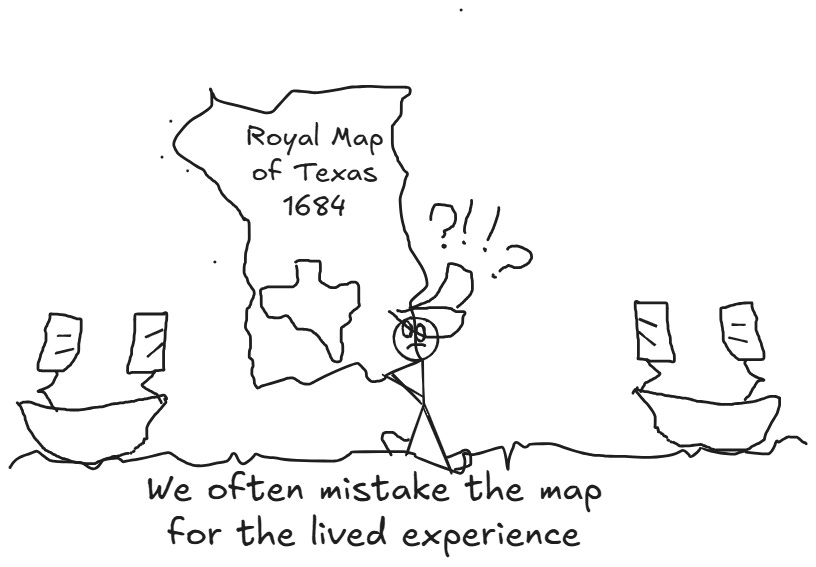
If he were alive today, seventeenth-century French explorer Sieur de La Salle would stand on the salt marshes of Matagorda Bay and scream it to the wind, water, waves, and God.
History records La Salle primarily as a land explorer who traced the Mississippi River all the way from Canada until it spilled into the Gulf of Mexico in 1682.
The very next year, the newly minted national hero sailed four ships from the homeland with three hundred colonists along for the adventure.
On this voyage, however, La Salle relied on faulty maps—a catastrophic error that caused him to overshoot his destination by hundreds of miles and land instead in the salt marshes of Matagorda Bay, Texas.
King Louis XIV’s ambitions for the voyage were a high-stakes geopolitical gambit. He sought a fortified stronghold to deter the Spanish and a sprawling colony to turn a paper claim into an empire.
Instead, all four ships were shipwrecked, stranding three hundred French colonists in an unforgiving Texas wilderness.
The royal plan on paper quickly dissolved into disease, starvation, and a bloody mutiny where La Salle was executed by his own men in the brush.
It stands as a brutal historical reminder: the map is not the territory, and putting complete, unquestioning faith in a map will cause you to miss the destination entirely—or, as La Salle proved, cost you your life.
Korzybski & Our Maps of Experience
Polish-American engineer and mathematician Alfred Korzybski famously observed in 1931 that “the map is not the territory.”
On its surface, the line sounds obvious to anyone who has ever held a paper chart or followed a GPS. But Korzybski was reaching far beyond geographic navigation.
He was diagnosing a deeper human flaw: our habit of replacing external reality with internal shorthand.
Human knowledge is structurally limited by our nervous systems and the incomplete symbols of language we use to represent reality.
We do not interact with objective reality itself. Instead, we filter every experience through a heavily edited mental brochure—blueprints, mental models, slogans, processes, and menus.
The moment we mistake our internal translation for the living wilderness, the trap locks. We begin to eat the menu instead of the meal. We praise the compass while refusing to walk the mountain.
Thomas à Kempis & The Scholastic Cartographers
Five hundred years before Korzybski issued his warnings, a 15th-century Augustinian monk—and the central focus of this series— furiously leveled the exact same warnings against the educational elite of his day.
In Book 1, Chapter 3 of The Imitation of Christ, Thomas à Kempis sent a clear message to the university scholars who had assigned themselves gatekeepers of all that is true and right:
“What good does it do you to be able to discuss the Trinity profoundly if you lack humility and so displease the Trinity? High-sounding words do not make a man holy or just... I would rather feel compunction than know how to define it.”
— Thomas à Kempis, The Imitation of Christ (Book 1, Chapter 3-)
The scholastics were spiritual mapmakers. Instead of focusing on actual contact and experience with the living Creator, they spent entire lifetimes creating, measuring, and writing in the margins of theological maps.
To them, myriad Latin definitions for grace, contrition, and sanctification were more important than experiencing the reality behind the words.
Thomas à Kempis understood that knowledge without lived experience is pure vanity—a distraction that inflates the intellectual ego while the soul starves in the desert.
Deifying the Map in the Meeting Room
Last week, in Issue #8 of this series, we introduced the Monk’s lesson via an opening scene set in a 12-step recovery meeting. This week, let’s revisit those same folding chairs for fresh insights on a new directive from à Kempis.
The Addition Machine—the worldly engine of endless “more”—has a signature maneuver. It takes a humble, hand-drawn survival guide and converts it into an unassailable Holy Text.
In 1939, Bill Wilson and the early pioneers of Alcoholics Anonymous sat down to draft the Big Book. In Chapter 11, they wrote an explicit, humble caveat:
“Our book is meant to be suggestive only. We realize WE KNOW ONLY A LITTLE.”
It is a line rarely mentioned in the rooms today.
They framed their twelve steps as a hand-drawn map—a rough, experiential compass cobbled together by a few desperate men who had stumbled out of the abyss. They were pointing toward a living territory of spiritual recovery.
Decades later, look at what the institutional machinery has done with that hand-drawn sketch.
Members debate page numbers, enforce rigid orthodoxy, and elevate fellow recovering drunks into infallible high priests—treating a sponsorship hierarchy never even mentioned in the original text as holy writ.
They treat the book and the program as the destination itself.
Arguing about the map is safe. It requires no vulnerability, no total surrender of the ego, and no direct encounter with God.
It is far easier to debate page 84 in a brightly lit fluorescent meeting room than to step into the undiscovered wilderness of actual spiritual transformation.
The Biometric Map on Your Wrist
The mapmaker’s imprint is by no means tucked away exclusively in the rooms of recovery. We can see the cartography of the Addition Machine everywhere today.
Look at the modern suburban worker. Each morning—before the shower, the first cup of coffee, or the simple act of silently greeting the day—they urgently tap their smartwatch or check a phone app for their health score.
Did they sleep well? How many minutes did they snore? What was their breathing rate? How high are their stress levels?
The algorithm will let them know in no uncertain terms. They are caught in the trap of a biometric map—worshipping the data readout while wondering why they remain chronically exhausted, anxious, and disconnected from the lived experience of morning peace.
And we do the exact same thing in our spiritual and intellectual lives. We hoard reading lists, consult social media to see what others are reading, cram in a daily email devotional, and collect slogans that reinforce our worldviews.
In short, we’re forever skimming the brochure of life, admiring the glossy pictures and pithy advice, while refusing to step into the wilderness itself.
This Week’s Subtraction Directive
Sieur de La Salle shipwrecked in the Texas salt marshes because he trusted a royal parchment over the actual coastline.
Thomas à Kempis called out the 15th-century scholastics for arguing over Latin definitions of grace while their souls starved in the cloister.
The early pioneers of recovery wrote a humble, hand-drawn map that later generations turned into rigid bureaucracy.
And today, modern workers check glass screens on their wrists to see if an algorithm gives them permission to feel rested.
The pattern of the Addition Machine is always the same: whenever we elevate the brochure over the living wilderness, we trade authentic, un-mediated grace for static control.
A map is a tool for a lost traveler—it was never meant to be worshipped, framed, or eaten.
If you want to experience reality, you must set the map aside and put your boots on the bare, un-engineered ground.
Here is your three-part assignment for the week:
Identify the Map: Pick one area of your daily routine where you rely on a proxy metric, tracking app, or abstract rule to tell you how you feel or what you should think (e.g., your morning smartwatch recovery score, a digital habit tracker, or an online opinion guide).
Burn the Chart: For the next forty-eight hours, deliberately banish that substitute. Take off the smartwatch, delete the app from your home screen, or close the tracking journal. Remove the middleman standing between you and your own raw experience.
Walk the Un-Engineered Territory: Perform the actual activity without measuring, recording, or optimizing it. Take a walk without counting steps; sit in prayer or quiet reflection without timing the session; eat a meal without checking a nutritional score. Experience the meal itself rather than studying the menu.
Put the maps away.
Walk the living territory.
Let it be.
To support this independent space or bring the clarity of subtraction to your own project’s philosophy, visit our foundation page.