

Welcome to The Subtraction Machine and installment #5 of our year-long modernization, dissection, and weekly exploration of Thomas à Kempis’s 15th-century Christian classic, The Imitation of Christ.
(New to this daring experiment? Read the prologue and rules of engagement here.)
Saturday morning. 9:56 a.m., and the parking lot of the local Costco was humming with activity.
I kept a keen eye out for the first spot and then aggressively secured the space with a textbook move designed to avoid being cut off by an over-eager minivan eyeing the same prize.
And then I saw her.
She was in her late 30s, attractive in an earthy way, and headed straight for her newer-model Subaru Outback—a nice, pearl-white one with an attached bike rack.
Of course, I’d never met the woman. But I knew her.
My cognitive software ran a quick diagnostic, and here is the summary report it delivered on the subject at hand:
The Bags: Canvas, organic, environmentally friendly.
The Boots: $220 Danner hiking boots, heavily laced.
The Shirt: A faded, green REI-branded cotton t-shirt.
The Bumper: A faded Bernie Sanders campaign sticker.
Hmmm… but what did the data mean?
I already knew her profile, and thus her entire life story, politics, and personal ethos, by her choice of car, the bike rack, the boots, and the bumper sticker.
In just a fraction of a second, the software in my head compiled the data, sorted the results, and delivered a neatly typed 11-page, single-spaced summary of her life.
I knew her personal philosophy, how she votes, where she vacations, and the exact list of left-leaning populist biographies she pores over while sipping fair-trade organic coffee.
And then the final drop completed her Costco parking-lot dossier.
As she squeezed behind the Subaru’s wheel, two books fell from her canvas bag and hit the damp asphalt.
One was T. Harry Williams’s massive biography of populist hero and Depression-era Louisiana governor Huey P. Long.
Exhibit A.
The other was Braiding Sweetgrass: Indigenous Wisdom, Scientific Knowledge, and the Teachings of Plants.
For the unwashed, the tome compiled by Robin Wall Kimmerer is the holy scripture of the Subaru-driving, reusable-tote crowd from coast to coast.
Case closed.
My brain filed her away with a summary description:
She is a left-leaning populist who eats organic quinoa porridge for breakfast, laments the death of the small family farm, and secretly wishes “The Kingfish” was running for senate in her district.
As I closed the file out on this complete stranger and headed for the entrance, a thought hit me hard.
And it stung with irony: I actually liked her.
A hardline libertarian, I hold little to no faith in government that reaches beyond road construction and the Library of Congress. I have even less in creeping corporate control of our lives.
Call me old fashioned, but I believe the individual - the solitary man or woman - is the most sacred, uncompromised unit of existence.
And yet here I was, betraying my deepest convictions. I was treating this free and beautiful woman with no more thought than the barcoded boxes of detergents and mixed nuts I would soon load into the back of my car.
My cognitive software flashed the warning message, “Warning! You’re from different tribes. Caution!”
My human instinct told me the opposite, however. Beneath the handy labels, I suspected she was educated, thoughtful and most likely open to deep and winding conversations about the things that really matter.
Upon reflection, I would have gladly shared communion and a cup of coffee with her at the local diner.
Honestly, I’d buy Karl Marx breakfast if only to spend an hour exploring the architecture of his mind.
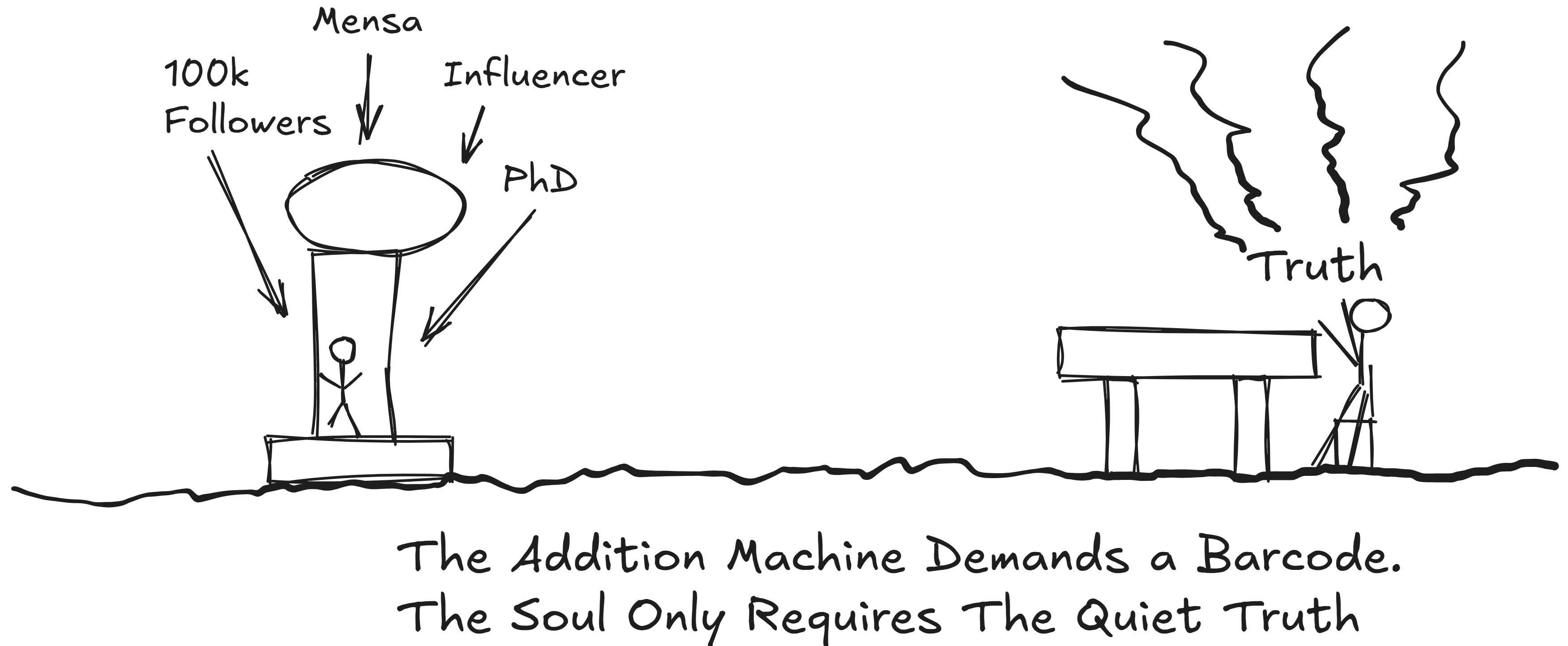
But the Addition Machine’s sorting system cannot allow communion. It thrives on division.
It doesn’t want us sitting in harmony at the local diner table, looking past the labels to explore the naked, unfiltered humanity sitting beside us. Instead, it mandates us to categorize, demonize, and build up walls.
In his classic poem, Robert Frost’s neighbor stubbornly insists, “Good fences make good neighbors.”
But Frost notes that his neighbor moves in a kind of darkness, blindly repeating an inherited script while carrying stones to build a wall that doesn’t need to exist.
The Addition Machine weaponizes those very walls and fences—our tribal silos, our digital bubbles—to ensure we never have to look each other in the eye.
Six centuries ago - Thomas à Kempis, a quiet German-Dutch monk, sat hunched over sheepskin parchment in a lamp-lit stone cell. He was carrying the weight of the same philosophical stones we carry still today.
He likely wouldn’t understand the infinite lifestyle and social labels we apply to each other. He certainly wouldn’t grasp the social currency of Costco vs Sam’s Club or driving a Ford truck vs a Volvo.
The labels he fought to dismantle in his era involved academic credentials, ecclesiastical lanyards and internecine theological squabbles.
Yet his diagnostic warning in Book 1, Chapter 5 of The Imitation of Christ strikes straight through the center of my Saturday morning Costco parking-lot audit:
“Likewise we ought to read simple and devout books as willingly as learned and profound ones. We ought not to be swayed by the authority of the writer, whether he be a great literary light or an insignificant person, but by the love of simple truth. We ought not to ask who is speaking, but mark what is said. Men pass away, but the truth of the Lord remains forever. God speaks to us in many ways without regard for persons.”
— Thomas à Kempis, The Imitation of Christ (Book 1, Chapter 5)
Read the monk’s admonition again carefully. He’s calling for a radical dis-armament—the active laying down of our ideological arms.
He’s telling us that our obsession with “credentials” is a trap, a clever trick that obscures the quest for truth by focusing our gaze entirely on the person delivering the message.
His message is stark: identity is vanity.
And the prestige, position, or pedigree of the speaker is often the very thing standing in the way of the truth.
The Confession: Notes from the Construction Site
I bore the burden of youth at the time and so I’d like to use this as a handy existential excuse—a personal mulligan, if you will.
But the monk’s warning hits me with a particular, cold weight. I spent my own early career operating inside the very factory floors where these credentialed illusions are built.
Back in the early 1990s, I worked as a marketing and high-tech writer for Texas Instruments. I was surrounded by credentials. And the badges didn’t only convey name, department and years of service.
These were brilliant men and women with PhDs from Stanford, MIT and other ivy-covered palaces of enlightenment.
I not only respected them, I passed them in the hallways with quiet veneration.
These were the scientists and engineers inscribing the future of human potential on software and silicon.
To the outside world, and certainly in my imagination, these were the high priests heralding a brave new world.
Yet during our design and marketing reviews, I watched a strange, silent blindness unfold. It seemed to me that despite the staggering brilliance on display, there was a pervasive unawareness of the spiritual cages they were constructing.
It’s true, the algorithmic dopamine delivery system we carry in our pockets today is primarily expressed in software.
But the hardware developers I worked with then were actively laying the concrete foundations of the prison—inscribing it onto silicon, a million integrated components at a time.
They were engineering the very brains that would serve as the silicon superhighways, transporting us straight into the lobby of a 24/7 behaviorist casino—where our souls are the ante on the table.
The engineers I worked with back then had the pedigree and good intentions to match.
That’s what engineers do—most of them anyway. They use their natural instincts and technical training to make lives better, more efficient and free from drudgery.
So, if the quiet Augustinian monk could step out of the shadows of his lamp-lit cell and look over our shoulders, what warning would he whisper?
Of course, I can’t say for sure. But I think he might advise us to perform some fairly radical updates on the ways we assign value to the message and the messengers we receive.
As you scroll through your feed today, your thumb goes on auto-pilot, scanning for badges of authority. You check the follower count. You audit the verified checkmark. You glance at the comma-laden list of self-important titles in the bio.
You do this because the Addition Machine has trained us to believe that the name on a badge or a multi-degreed pedigree is a seal of approval.
We note who is speaking because we are terrified to evaluate the words on their own. We have traded naked, simple truth for the comforting delusion of the world’s approval.
If we ever hope to hear truth’s transmission again, we must follow the monk’s advice and refuse “to be swayed by the authority of the writer.”
The Active Subtraction Directive: The Pedigree Fast
This brings us to our collective assignment for the week ahead—an intentional dismantling of our own sorting software. For the next seven days, we are going to practice The Pedigree Fast.
The Trigger: When you engage a piece of writing, an article, a video, or an opinion online.
The Mechanics: Before you read the first sentence, explicitly refuse to look at the author’s bio, their subscriber count, their credentials, or their name. And if your thumb is tempted to wander up the scroll, simply stop. Let the urge to verify their “tribe” or their “social standing” sit alone.
You most likely didn’t know their name when you woke up. Knowing it now won’t change your day. Force your mind to evaluate the message itself with no thought of the author.
The Result: You—we all—will discover that truth does not require a badge. And often, the quietest, most “insignificant” voice is the one carrying life-sustaining insights.
Hold the questions. Strip the labels.
Protect the sanctity of your soul.
Let it be.
To support this independent space or bring the clarity of subtraction to your own project’s philosophy, visit our foundation page.
Thought provoking… enjoyed article!